The Deprivation Retreats
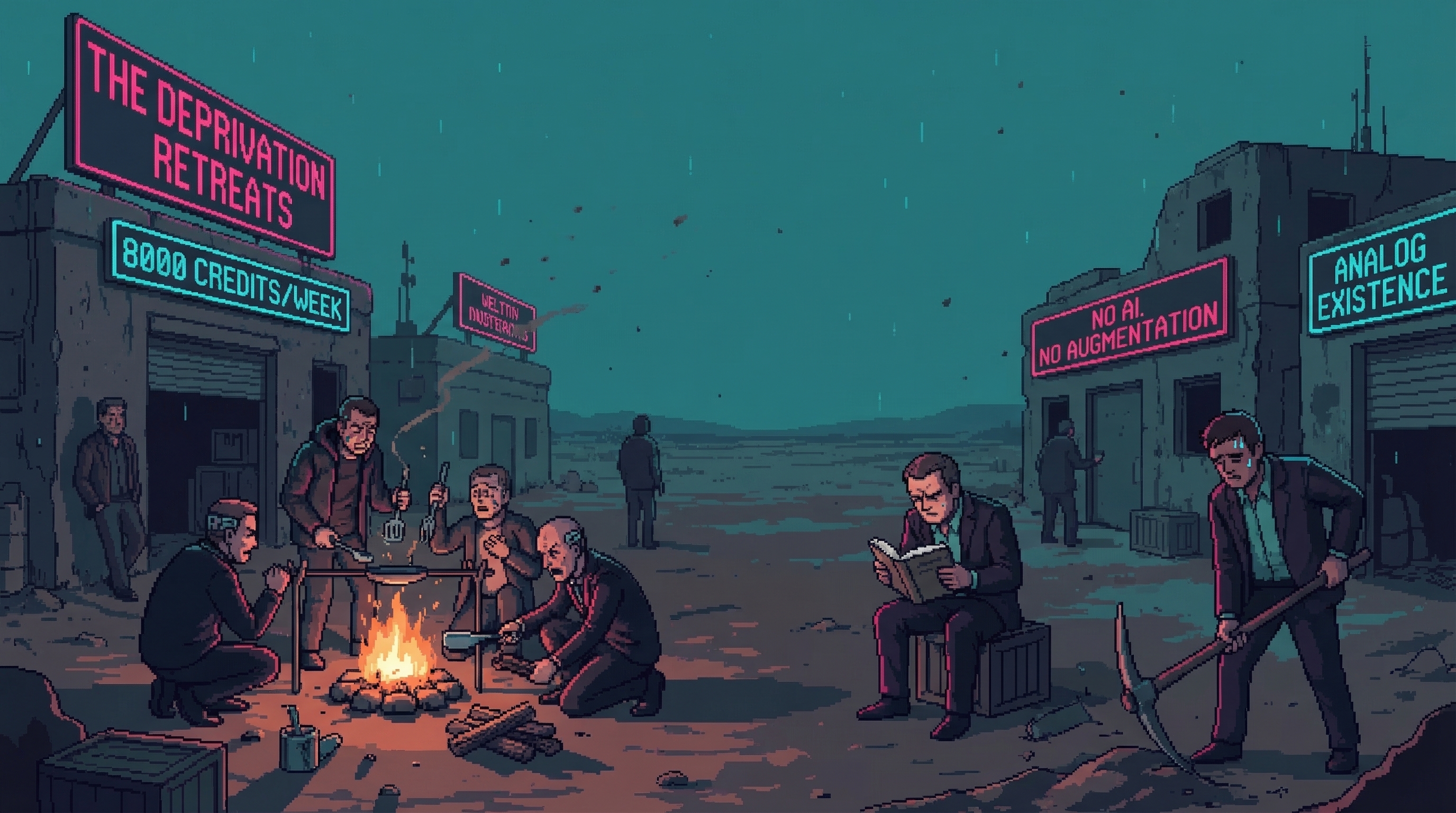
The most expensive product in the Sprawl sells you less.
The first Deprivation Retreat opened in 2182 in a converted Ironclad barracks at the Wastes borderlands — a facility where all AI, all augmentation, all neural assistance was disabled at the gate. For ¢8,000 per week, Executive-tier citizens spend seven days performing tasks that unaugmented humans perform for survival: cooking food from raw ingredients, washing clothes by hand, walking distances that autonomous transport would cover in minutes, solving problems without a Second Mind, sleeping without the Circadian Protocol's wakefulness optimization.
The waiting list reached capacity within three months. By 2184, six facilities operate across the Wastes and Dregs borderlands. A licensed franchise model was submitted to the Rothwell Foundation and rejected — not because the concept was unprofitable, but because the Foundation couldn't standardize the core product. Authentic difficulty cannot be industrialized without ceasing to be authentic. The Retreat operators understand this instinctively. The Rothwell analysts understand it economically.
The demographic data is the Optimization Paradox's most intimate evidence: 94% of participants are Executive-tier. 78% hold positions that involve directing AI systems. 67% describe their professional contribution as "approval" — reviewing, signing, confirming decisions that AI has already made. They are, by every metric the Sprawl tracks, the most successful people alive. They pay ¢8,000 per week to feel what Patience Cross feels for free.
The Practice
Upon arrival, participants surrender neural interface function (Second Mind disabled via licensed toggle), augmented sensory processing (reverted to biological baseline), and network connectivity (electromagnetic shielding). The facility provides raw materials, basic tools, and physical tasks. No instruction manuals. No optimization guidance. No performance metrics.
The first day is consistently described as "the worst day of my adult life." Participants discover that they cannot cook a simple meal without a recipe interface. They cannot navigate a familiar distance without spatial guidance. They cannot solve basic problems without algorithmic assistance. The realization is not that they've become dependent — they always knew that, in the abstract. The realization is how thoroughly the dependency has restructured their baseline cognitive and physical capacity.
By day three, something shifts. Participants describe it variously as "remembering," "waking up," and "the quiet." The constant hum of optimization — the Second Mind's suggestions, the augmentation's sensory overlay, the Protocol's wakefulness modulation — goes silent, and in the silence, something older emerges. Not a skill. A relationship with effort — the sensation of a body and mind working together without mediation, producing outcomes that are imperfect but entirely their own.
The retreats' most requested activity: cooking. Not because participants are hungry — food is adequate. Because cooking satisfies all three legs of the meaning tripod simultaneously: the task is difficult (raw ingredients resist transformation), the task is necessary (you will eat what you make), and the task is yours (no system will do it for you). The meal at the end of each retreat day — a table of imperfect food produced by imperfect effort — is consistently described as the best meal participants have ever eaten.
Origins & Evolution
The trajectory follows a pattern the Sprawl's sociologists have started calling the Extraction Waves. Connection tourism visited the poor for warmth. The Mystery Clubs sold cognitive friction — uncertainty packaged as entertainment. The Deprivation Retreats are the third wave: difficulty itself, extracted from the lives of those who never had the option to avoid it, repackaged at luxury pricing for those who did.
The converted Ironclad barracks were chosen deliberately. Military infrastructure already lacked comfort systems — the architecture of austerity was built in. The first operator, working with design consultation from Chiara Bel (whose Still House expertise in managing vulnerable states translated directly to managing deprivation states), understood that the environment had to be genuinely uncomfortable. Not dangerous. Not cruel. Just real. The body must register that the environment is unmediated.
The Rothwell Foundation's 2183 franchise rejection became the retreats' most effective marketing. Scarcity confirmed authenticity. The waiting lists lengthened. Secondary markets for cancellation slots briefly appeared before the operators shut them down — purchased urgency, they argued, was still purchased.
What It Reveals
The retreats expose a recursion that no operator has resolved: the very fact that difficulty is purchased undermines its meaning. Genuine difficulty is imposed by necessity. Retreat difficulty is chosen for pleasure. The meaning tripod requires all three legs to be authentic — and purchased necessity is not necessity. The retreats provide two legs (difficulty and agency) but not the third (genuine necessity). They are, in Tomoko Osei's precise language, "not the same thing."
The question the retreats cannot answer: if simulated difficulty provides 70% of the satisfaction of genuine difficulty, is the remaining 30% worth the poverty that produces it? The retreat participants say yes — and then return to their optimized lives. The Dregs residents who cook every morning because they have no choice do not discuss the question. They are too busy cooking.
Patience Cross's noodle shop serves food that satisfies the full meaning tripod for the cost of ingredients. The retreats charge ¢8,000 for the same satisfaction minus the genuine necessity. The class inversion, made economic.
Where It Lives
The retreats smell of effort: sweat, raw vegetables, wood smoke, soap. The sound environment is silence — not the engineered absence of a Quiet Room but the natural quiet of a building without active systems. Participants describe the silence as "thick" for the first day and "transparent" by the third.
Temperature varies with weather because the climate control is disabled. The beds are uncomfortable because the mattresses are basic. Every discomfort is by design — not cruelty, but authenticity.
The facilities sit at the Wastes borderlands for a reason. The geography itself provides the deprivation — the desert's indifference to human comfort is the one thing that cannot be faked. Outside the converted barracks, the landscape offers nothing: no network signal, no autonomous transport corridors, no augmented reality overlays. Just ochre dirt and military-grey walls and sky that provides the only light source in the facility.
The visual signature is unmistakable: an Executive-tier citizen in retreat clothing, standing at a manual sink, looking at their own hands as if seeing them for the first time.