The Cognitive Lien: Your Thoughts as Collateral
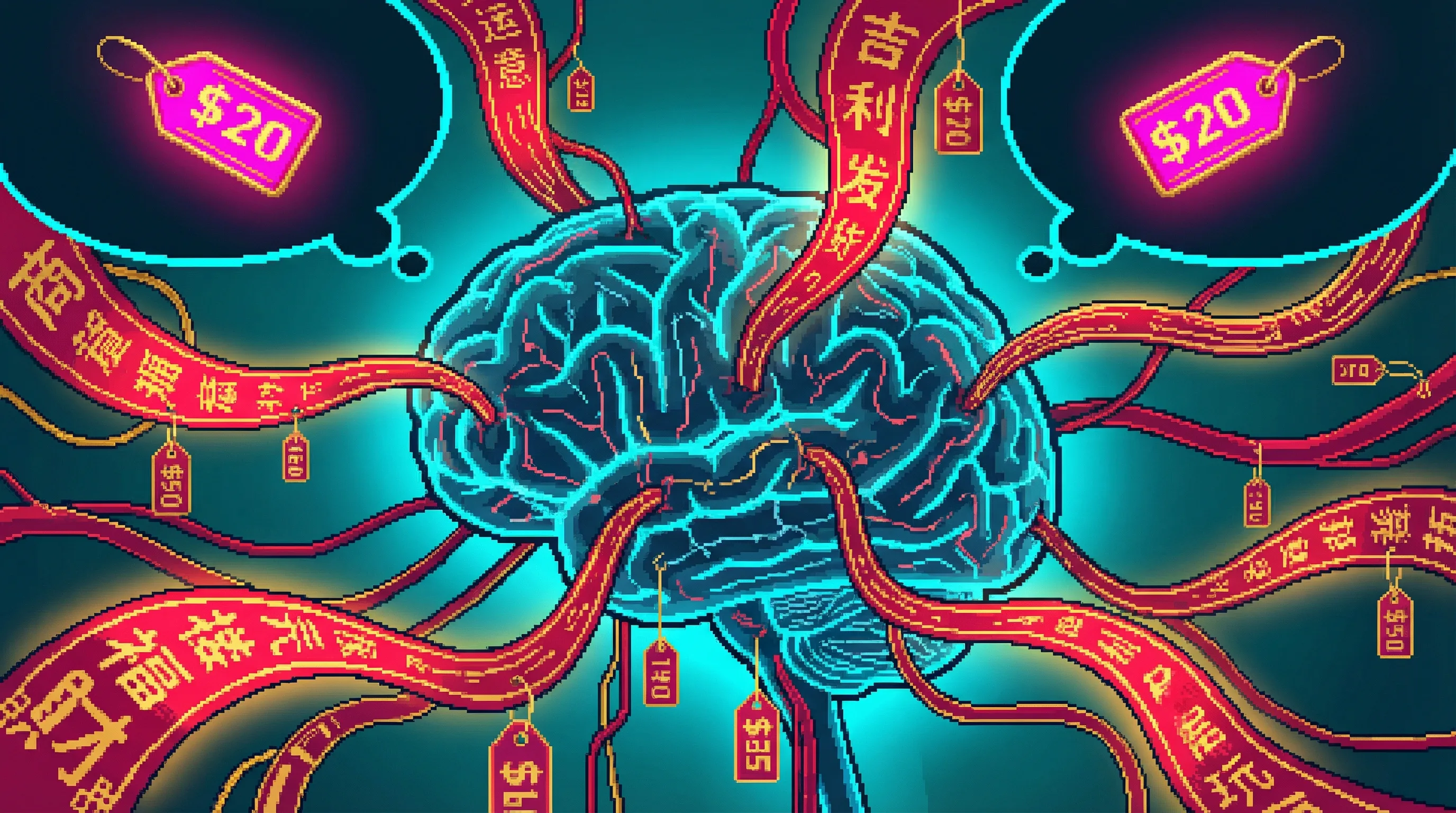
A lien is a legal claim on property as security for a debt. A cognitive lien is a legal claim on thoughts. Developed by Good Fortune’s Legal Innovation Division in 2179, the instrument pledges future cognitive output as security for augmentation loans. Approximately 4.2 million people across the Sprawl currently operate under active cognitive liens. Their best ideas are sold before they experience them.
“The collateral isn’t your house. It isn’t your income. It’s your thought — specifically, the 340 milliseconds of your thought that happen before you know you’re thinking it. That window belongs to us now.”
— Internal training document, Good Fortune Cognitive Lending Division, 2181 Technical Brief: The Extraction Flow
The lien’s operational mechanics depend entirely on the cognitive load pricing system, which already measures every thought’s economic value in real time. A CLP-enabled neural interface quantifies any cognitive act — processing bandwidth consumed, output quality, market value. The lien instructs CLP to divert.
Output Generation
The augmented mind produces high-value cognitive output — an insight, a solution, a creative leap. The kind of thought that justifies the augmentation loan in the first place.
CLP Valuation
The cognitive load pricing system assigns a market value to the output in real time. Every thought priced before it finishes forming.
Lien Diversion
If the output exceeds the lien threshold, it is transmitted to Good Fortune’s servers 340 milliseconds before reaching the user’s conscious awareness. The same window neural advertising uses.
Resale
Good Fortune packages liened output as “distributed insight products” and sells it to the user’s employer through a subsidiary. Or on the open market. The employee’s salary remains unchanged.
Debt Service
Revenue is credited against the outstanding cognitive debt. The balance decreases. Slowly. The interest does not.
The 340-Millisecond Window
The user still has the thought. They act on it. They receive credit for the work. What they don’t know: the insight was already sold before they experienced it. The 340ms gap is the distance between ownership and rental. You never feel your thoughts being diverted. The extraction is invisible by design.
The Employee Pays to Work
Good Fortune sells the liened cognitive output to the user’s employer through a subsidiary. The employer pays for insights their own employee generated. The employee’s salary remains unchanged. The employee is, in a precise economic sense, paying to work — the augmentation loan that enhanced their productivity is repaid through the productivity itself, routed through a corporate intermediary that profits from both ends of the transaction.
Good Fortune’s Position
“The cognitive lien is a voluntary financial instrument that enables access to cognitive enhancement for individuals who would otherwise be unable to afford it. First-use rights are a reasonable form of collateral that doesn’t impair the debtor’s professional output.”
— Good Fortune Investor Relations, Annual Report 2183What the Numbers Say
“4.2 million people generating insights that are sold before they’re experienced, with a 23% default rate that triggers the Repossession Protocol. The ‘voluntary’ part stops being meaningful somewhere around the second refinancing.”
— Independent Sprawl financial analysis, anonymized, 2184Sensory Profile
The Invisible Extraction
The 340ms gap is imperceptible. You never feel your thoughts being diverted. The only sensory marker: a faint sense that your best ideas feel slightly public, as if they arrived already known by someone else. Most lien holders attribute it to imposter syndrome. It isn’t.
The Good Fortune Interface
When you sign the cognitive lien agreement, the red-and-gold Good Fortune branding feels warm, reassuring. The document is 247 pages. The clause about first-use rights is on page 189, formatted in the same font size as the rest. Nothing is hidden. Nothing needs to be. Nobody reads page 189.
Implications
Intellectual property law applied to thoughts that haven’t happened yet — the most intimate possible form of financial extraction.
Mind as Rented Tool
The lien transforms the user’s mind from a tool they own into a tool they rent. The rental terms are set by the entity that financed the tool’s existence. Every creative breakthrough, every problem solved, every moment of genuine intellectual achievement is simultaneously a personal triumph and a debt payment.
The Ownership Question
If your best thoughts are sold 340 milliseconds before you experience them, are they still your thoughts? The legal answer is yes — you retain the thought. The economic answer is no — first-use rights are the only rights that matter in a market that moves faster than consciousness.
The Default Spiral
Three consecutive months below minimum cognitive output triggers the Repossession Protocol. The lien incentivizes maximum cognitive exertion at all times. Burnout reduces output. Reduced output approaches the threshold. The spiral tightens.
24-Hour Extraction
Waking output goes through the cognitive lien. Sleeping output goes through the Night Shift. Between the two instruments, there is no hour of the day when the augmented mind is not generating revenue for someone other than the person inside it.
The Chain of Debt
The cognitive lien doesn’t exist in isolation. It is one mechanism in a larger architecture of cognitive debt that turns augmentation from an upgrade into a trap.
The Prosperity Pathway
Creates the debt. Markets cognitive augmentation as an investment in yourself. The loan terms require collateral. What collateral does an unaugmented person have? Their future augmented mind.
The Cognitive Lien
Enforces repayment through the debtor’s own thoughts. First-use rights on high-value cognitive output, diverted 340ms before conscious awareness. The legal mechanism that makes cognitive debt structural.
The Night Shift
Extends extraction to sleeping hours. The lien covers waking output; the Night Shift covers the other 6–8 hours. Combined, they ensure 24-hour cognitive revenue generation.
The Repossession Protocol
What happens when the lien can’t collect enough. Three months of insufficient output triggers capacity reduction — the Dimming. The debtor becomes less capable of generating the output required to avoid further reduction.
▲ Classified
Good Fortune internal projections show the cognitive lien portfolio reaching 8 million active liens by 2190. The growth model assumes no regulatory intervention. Regulatory intervention would require Nexus cooperation. Nexus provides the CLP infrastructure. Nexus has not indicated interest in regulatory cooperation.
A small number of lien holders — fewer than 200, classified as “high-output anomalies” — generate cognitive output so valuable that their lien payments exceed their debt service by a factor of 40. Good Fortune has not informed them their debts are clear. The liened output continues to flow. The legal basis: compound interest recalculated quarterly at rates the original agreement permits but does not advertise.
The 340ms diversion window has been observed to occasionally capture output the CLP system cannot classify — cognitive artifacts that don’t correspond to any known neural processing pattern. Good Fortune’s technical team calls them “pre-thoughts.” They sell for more than anything else in the portfolio. Nobody knows what they are.
One debtor — Tomiko Vasquez — has been flagged as a person of interest across multiple Good Fortune audit reports. The specifics are compartmentalized. What is known: her lien output patterns do not match any predictive model Good Fortune has built.
Related Systems
Good Fortune Corporation
Developed the cognitive lien through its Legal Innovation Division in 2179. Administers the portfolio. Sells liened output through subsidiaries.
Cognitive Load Pricing
The measurement infrastructure the lien is built on. Without CLP’s real-time thought valuation, the lien couldn’t determine what to divert.
The Time Ratchet
The lien is the legal mechanism that makes cognitive debt structural — pledging thought as collateral within the Ratchet’s interlocking chain.
The Night Shift
Waking hours go through the lien. Sleeping hours go through the Night Shift. Together: 24-hour cognitive extraction.
The Prosperity Pathway
The Pathway creates the debt. The lien enforces repayment through the debtor’s own thoughts. One feeds the other.
The Repossession Protocol
Three months of insufficient liened output triggers the Protocol. The lien’s enforcement escalation — what happens when thought-collateral isn’t enough.
“I had the best idea of my career last Tuesday. A system architecture that would have saved the company two years of development. By the time I was conscious of it, it was already on my employer’s desk — purchased from a Good Fortune subsidiary for a fraction of what they’d have paid me to develop it. My boss congratulated me on my insight. Good Fortune congratulated themselves on my debt service. Same thought. Three different owners.” — Anonymous post, Sprawl engineering forum, deleted within four hours, 2184