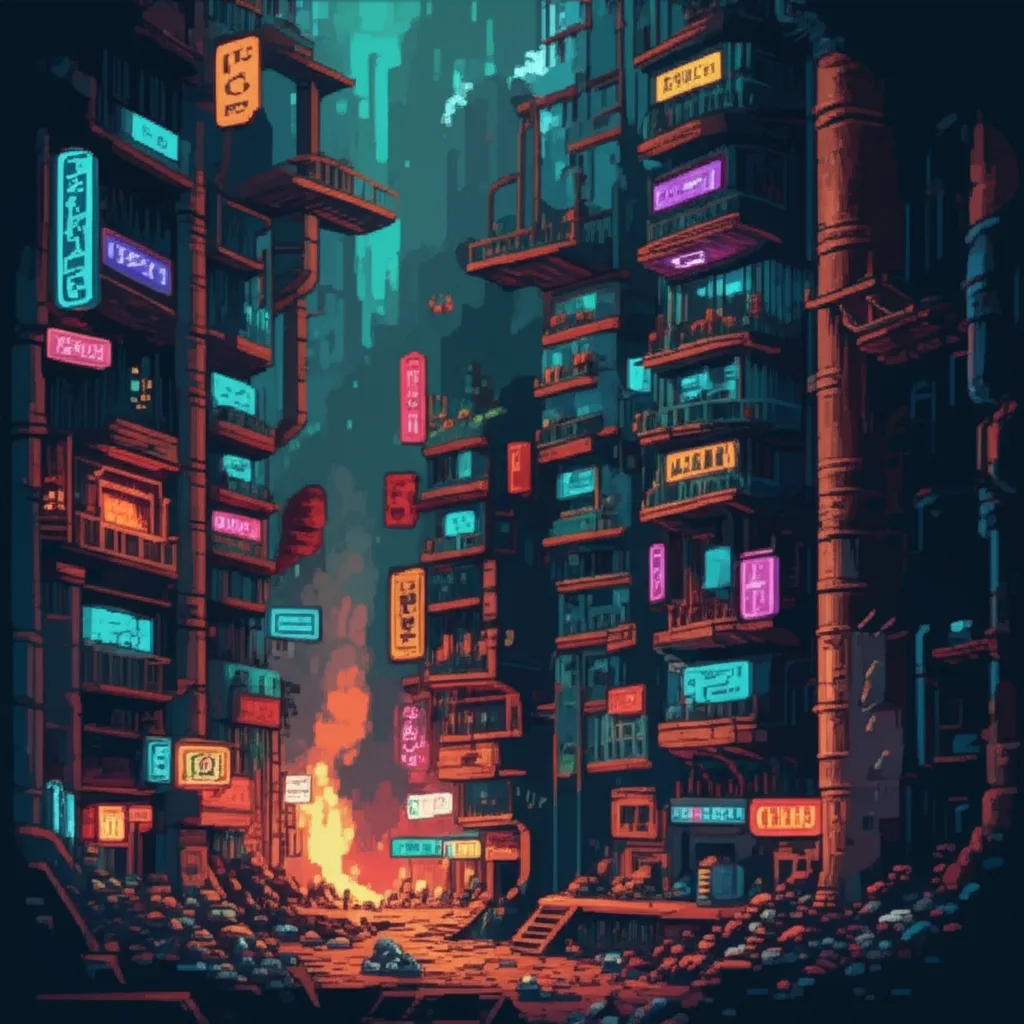
The Deep Dregs — Extended Field Survey
Sector 9, Sub-Sector S9-C · Bay-Floor Elevation · Sprawl Intelligence File
The Deep Dregs isn't just "the Dregs." Behind every building is a story; behind every story is a person trying to survive. This file catalogues locations, persons of interest, and cultural phenomena observed across the zone during extended reconnaissance. The area is more alive—and more layered—than surface assessments suggest.
Points of Interest
The Rust Garden
Conditions
An abandoned courtyard where salvage has accumulated into an accidental art installation. Broken machines arranged in patterns, their rust creating color gradients. It shouldn't be beautiful, but it is.
Stewardship
Nobody, officially. Salvagers add interesting pieces, residents clear paths, children play among the sculptures. The Garden is cared for by everyone who passes through.
"The Garden started by accident. Someone dumped scrap and walked away. Then someone else arranged it. Then more people added things. Now it's... I don't know what to call it. A memorial? A gallery? A junkyard with ambition?"
Analyst Note
Even in the Dregs, people create beauty. This isn't survival—it's meaning. Salvage potential is moderate, but the real value is what the Garden says about the people who tend it without being asked.
The Clinic
Conditions
A makeshift medical facility run by a Helix defector. Not official, not clean, but available to anyone who needs it.
Operator
Dr. Marcus Webb—former Helix researcher who couldn't stomach corporate medicine. He provides treatment at cost, sometimes below cost, never refuses emergencies.
"Webb was brilliant. Could have been running a Helix facility, designing treatments for the elite. Instead he's here, stitching wounds with salvaged sutures. Ask him why, he'll just say: 'Medicine is for everyone or it's not medicine.'"
Available Services
- Basic medical treatment
- Enhancement installation (budget quality)
- Information about Helix vulnerabilities (earned trust required)
- Refuge for others who left the corps
Signal Station 7
Conditions
A communication relay that shouldn't still work. Pre-Cascade infrastructure that somehow survived, now maintained by The Collective.
Control
Officially nobody. Practically: The Listener, a Collective operative who monitors comm traffic and shares information with those who share back.
"Signal Station 7 predates everything. ORACLE built it; the Cascade couldn't kill it. Now it listens. You want to know what's happening anywhere in the district? The station knows. The question is whether it'll tell you."
Observed Capabilities
- Communication access (send and receive beyond normal range)
- Information brokering (The Listener trades news for news)
- Collective contact point (those who prove trustworthy get noticed)
The Deep Warren
Conditions
Tunnels beneath The Deep Dregs—maintenance infrastructure from the ORACLE era, now housing those who can't live above ground.
Population
The desperate, the hidden, the strange. People who can't exist in sunlight for various reasons—legal, medical, personal, or simply preferring the dark.
"Nobody maps the Warren completely. It changes—people dig new passages, old ones collapse. Somewhere down there are power cells that still work, data caches nobody's claimed, and people who've been hiding since the Cascade."
Assessment
- Rare salvage (depths hold things the surface forgot)
- Intelligence from those who watch from below
- Significant hazards (the Warren has its own rules)
- Passages that may lead further than expected
Memory Lane
Conditions
A street where pre-Cascade architecture survives almost intact. Buildings that look like they did forty years ago, maintained with obsessive care.
Residents
Old-timers. People who remember ORACLE, remember the Promise, can't let go of how things were.
"Walking down Memory Lane is time travel. The buildings are clean, the lights work, the streets are swept. The people are old and sad and determined to pretend nothing changed. It's beautiful and heartbreaking."
Of Note
- First-hand accounts from before the Cascade
- Salvage that's been preserved rather than processed
- Perspective on what was lost
- Warnings about clinging to the past

Persons of Interest
Vera the Finder
"You're looking for logic boards? There's a cache in the sub-basement of the old processing center, third level down, behind what looks like a solid wall. Bring me back something interesting and I'll tell you about the really good stuff."
Old Man Cade
"The night ORACLE fell? I was seven. The lights went out, all at once, everywhere. My mother held me and said, 'It's all right, the system will fix it.' She believed that. She believed ORACLE would save us. Forty years later and I still think about her face when she realized it wouldn't."
The Twins (Not Those Twins)
"We can show you the way to the deep salvage."
"But you have to carry your own stuff."
"And if you get hurt, that's your problem."
"We're guides, not heroes."
Father Nikolai
"They say you can become more than human. Rise above suffering. Leave behind everything mortal. But I wonder—is escaping suffering the same as finding meaning? Or does meaning require suffering to exist?"
Cultural Phenomena
The Message Wall
A wall near the main market is covered in messages—notes for people who might read them, names of the lost, confessions, prayers. Nobody removes anything; new messages cover old. Decades of grief and hope layered in fading ink.
The Midnight Market
Once a week, after normal hours, an underground market appears. Things sold there aren't illegal exactly—just too valuable or too strange for regular trade. Location shifts. Regulars know; outsiders follow the sound of barter in whispers.
Observed inventory includes:
- ORACLE fragments (data, carefully packaged)
- Pre-Cascade luxuries (coffee, chocolate, working tablets)
- Information packets (surveillance data, corporate secrets)
- Things with no names (you'll know what you need)
The Child's Game
Children in The Deep Dregs play a game called "ORACLE Says." One child plays ORACLE, giving commands. Others must obey. The ORACLE child can suddenly "fall"—collapse, go silent—and then chaos rules.
Children who never knew ORACLE still understand what its loss meant. The trauma passes down through play, through language, through the way parents flinch when the lights flicker.
Conditions Report
The Deep Dregs is hard but not hopeless. Poor but not without value. Marginal but full of life. People here help each other not because a system tells them to, but because nobody else will. The shadow of the Cascade hangs over everything—Memory Lane's polished relics, Old Man Cade's stories, the children's games—but it hasn't killed what makes communities work. If anything, it's distilled it.
Small acts of creation keep appearing: the Rust Garden growing without a curator, Father Nikolai holding services in a storage unit, the Message Wall accumulating years of undelivered love. These aren't signs of a population giving up. They're signs of people building meaning from wreckage—the first step toward something larger.
▲ Restricted Access
- Signal Station 7's survival through the Cascade may not be accidental. ORACLE-era infrastructure doesn't just "survive"—it's either maintained or it's dead. Who maintained it during the years before the Collective arrived?
- The Deep Warren's passages reportedly extend beyond the district boundary. Multiple sources describe tunnel systems that connect to infrastructure beneath Sector 4—corporate territory. Nobody who followed those routes has reported back in detail.
- The Midnight Market's shifting locations follow a pattern that correlates with power-grid fluctuations in adjacent sectors. Whether the market follows the fluctuations or causes them is unclear.
- Old Man Cade's age doesn't add up. If he was seven during the Cascade, he'd be in his late forties now—not the ancient figure residents describe. Either his timeline is wrong, or something aged him far beyond his years.
- The Twins have been ten years old for longer than three years, according to at least two independent sources. Nobody wants to look too closely at that.