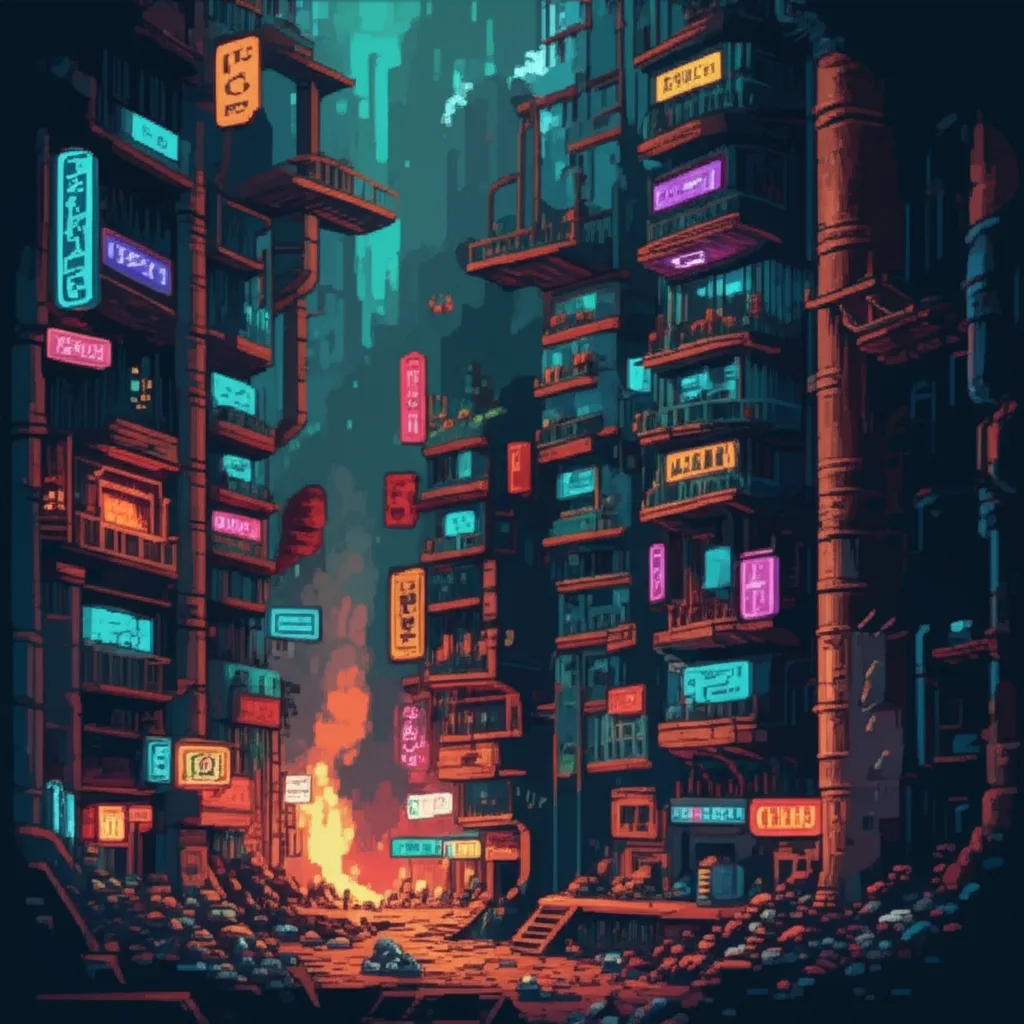
The Deep Dregs
The Dregs
The Deep Dregs—known to its residents as "The Dregs"—is a mid-tier salvage zone in the Sprawl's underbelly. It's where electronics come to die and where people come when they have nowhere else to go.
The sector sits in the shadow of the Ironclad-controlled industrial core, receiving the constant flow of waste that the megacorps discard. For most of the Sprawl, the Dregs doesn't exist. It's a footnote in logistics reports, a destination for waste management contracts, a place where people fall and don't climb back out. But for those who live here, it's home. And for those who know where to look, it's opportunity.
This is where you find the ORACLE shard. This is where everything begins.Conditions Report
The Smell
Burnt plastic, ozone, and something organic best not to think about. The temperature runs warm from the processing heat of a thousand basement smelters, cooling only at night when the power grid can't sustain the load.
The Light
Natural light doesn't reach below Level 4. Even above that, the megastructures block most of the sky. What illumination exists comes from salvaged LEDs, flickering holosigns, and the occasional fire barrel.
The Air
Thick with particulates. Smart residents wear filtration masks. Desperate ones develop the Dregs Cough within a year.
The Sound
Days: clatter of salvage sorting, whine of smelters, the distant rumble of Ironclad cargo transports overhead. Nights: music leaking from drinking holes, distant gunfire, synthesized street preachers warning about the Cascade's return.
When the baseline hum stops—power transformers, coolant pumps, ventilation systems—smart residents start running. Silence in the Dregs means something went very wrong.
The danger level rates low-tier. The Dregs won't kill you for existing, but it won't save you either. Territorial disputes stay relatively contained. The Collective maintains informal peace through economic pressure: start a war, lose access to the supply networks. Ironclad security patrols happen on schedules predictable enough to avoid.
The real dangers are environmental: toxic spills, structural collapses, equipment malfunctions. And occasionally, something crawls out of the deep salvage that was supposed to stay dead.
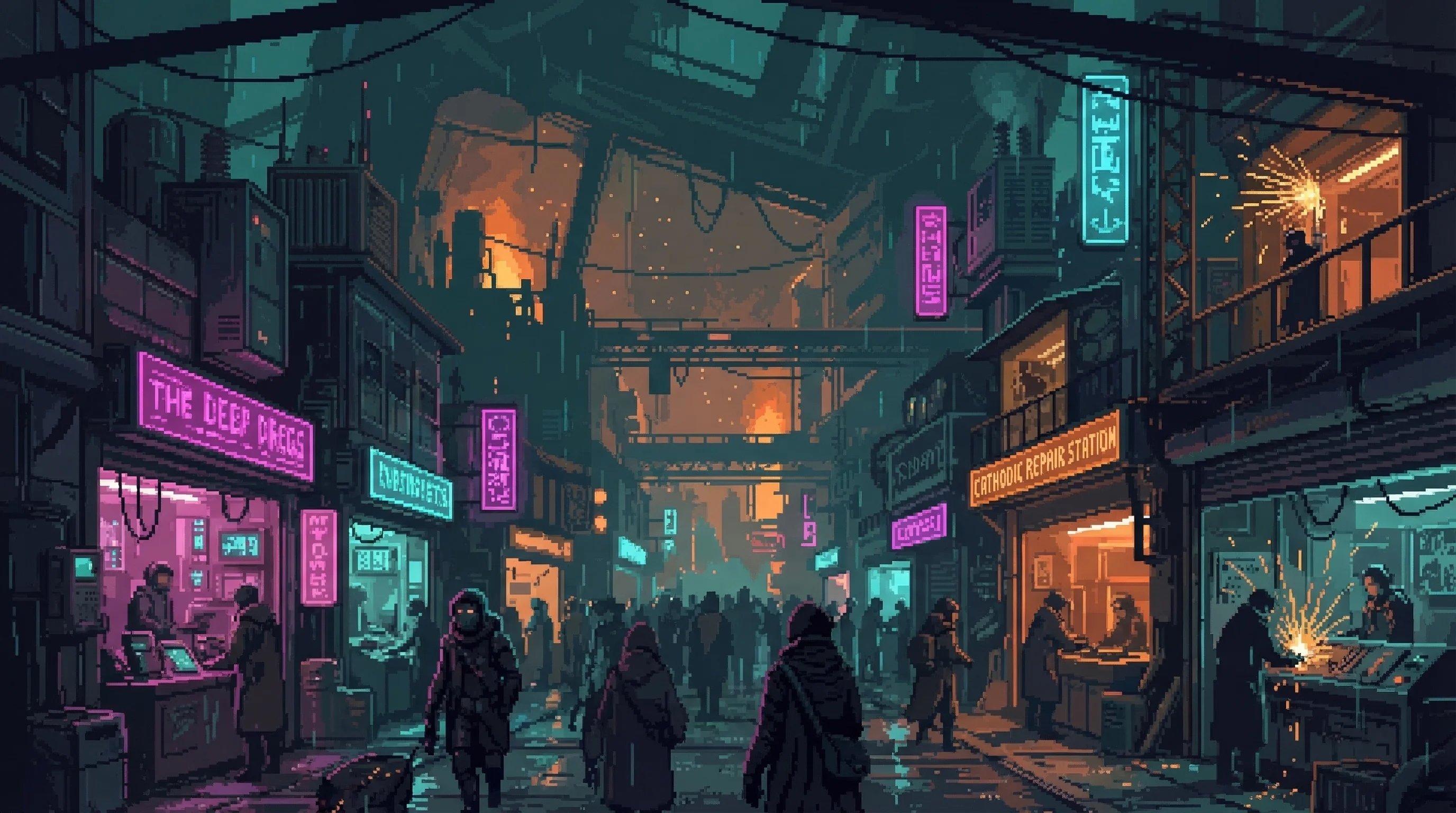
Vertical Structure
The Deep Dregs is built into and around a collapsed megastructure from the pre-Cascade era. The original building was a corporate logistics hub; now it's a vertical slum carved into its corpse.
Levels -4 to -1 — The Deep
Flooded basements, unstable foundations, rumored pre-Cascade archives. Only desperate salvagers venture here. Some don't come back. Some come back changed.
Levels 0-3 — Street Level
The main thoroughfare. Markets, workshops, living spaces carved from shipping containers and prefab units. Where most commerce happens.
Levels 4-8 — The Stacks
Denser residential. Stacked hab-units connected by catwalks and jury-rigged elevators. Better air quality, worse structural integrity.
Levels 9-12 — Topside
The "nice" part of the Dregs—relatively. Established salvage operators, Collective meeting points, the closest thing to natural light. Still impoverished by Sprawl standards.
Points of Interest
The Pit (Central Market)
Level 0-2A crater where the old logistics hub's atrium collapsed. Now a three-level open market where anything can be bought or sold. The Pit operates on reputation: known sellers have regular spots, newcomers work the edges until they earn their place.
- Raw salvage sorted by grade
- Repaired electronics of dubious quality
- Street food of questionable origin
- Information, if you know who to ask
- The Collective's unofficial representatives
Nominally independent, actually Collective-influenced. Ironclad security passes through on patrol but doesn't interfere with commerce unless something very illegal surfaces.
Sump Row
Level -1The lowest accessible level without serious equipment. Where the smelters operate—e-waste becomes scrap alloy, circuit boards surrender their conductive film. The smell of molten metal and burnt plastic is overwhelming.
- Scrap smelters belching smoke and profit
- Power-tap operations stealing grid capacity
- Black market coolant dealers
- The desperate and the determined
Ironclad occasionally raids for "unauthorized metallurgy" but mostly leaves Sump Row alone. It's too profitable for everyone to shut down.
The Cathodics
Level 6A cluster of hab-units centered around a pre-Cascade electronics repair shop that somehow still operates. The owner—known only as "Patch"—repairs anything, no questions asked. The Cathodics has become an informal community hub: part market, part community center, part neutral ground.
- Electronics repair and upgrade services
- Technical education (informal, fee-based)
- Collective dead drops (rumored)
- The closest thing to community the Dregs has
The Collective considers The Cathodics under their protection. Nobody messes with Patch.
The Socket
Level 3, HiddenA basement beneath a collapsed data center. The Dregs' connection to the wider net. Collective-operated, it provides gray-market network access to those who can pay or trade. This is where data scrapers upload their finds, where clean data gets packaged and sold, where the information economy of the underground flows.
- Network access (expensive but anonymous)
- Data trading and brokering
- Collective recruiters assessing talent
- Pre-Cascade database fragments (rare, valuable)
The Collective runs The Socket. Period. Ironclad knows it exists but can't find it. Nexus knows it exists and very much wants to find it.
G Nook 9
Level 4, UnmarkedIf you don't know where it is, you're not supposed to be there.
One of El Money's underground cyber cafes, disguised as an abandoned water reclamation office. The entrance is through a maintenance corridor that officially leads nowhere. Inside: rows of anonymous terminals, private booths with signal shielding, and the faint hum of cooling systems that shouldn't exist in a building this old.
- Anonymous network access (better than The Socket, different network)
- Neutral ground for underground meetings
- Information trading (rumors, job postings, warnings)
- The S-Money Memorial Terminal (runs thousands of media streams, nobody touches it)
- Safe house services for runners in transit
G Nook is neutral territory. El Money's rules: no heat, no questions, no recording. Break the rules and you're out—permanently. Regulars say a sleek chrome cat sometimes watches from the shadows. They say the cat reports to someone. They don't say who.
Ironclad Depot 7G-Tertiary
Level 0, EdgeThe only official corporate presence: a fortified depot where Ironclad waste management processes incoming e-waste. Its cargo haulers pass through constantly.
- Legitimate employment (low-paid, high-risk)
- Entry point for salvage supply
- Corporate security watching the border
- The occasional "donation" of interesting waste
Ironclad controls this absolutely. Security is real. Trespassing is punished. But depot workers sometimes look the other way for the right price.
▲ Restricted Access — The Shard Site — Level -2
Not marked on any map. Coordinates shared by word of mouth among the Collective's most trusted.
Somewhere in the flooded basements, in a chamber that was once a server farm, something lies dormant. ORACLE fragments have been found here—more than anywhere else in the Sprawl. The Collective monitors the site, debates what to do with it, and watches for anyone showing unusual interest.
This is where you find your shard. This is where everything changes.
Economy
Salvage
E-waste flows in from Ironclad contracts; scrap alloy, conductive film, and recovered components flow out. Every resident connects to the salvage economy, directly or indirectly.
Processing
Smelters, film processors, and component recovery operations. Technically illegal—Ironclad holds processing rights—but universally tolerated.
Services
Repair, modification, and installation for those who can't afford corporate options. Street-grade augmentation, equipment mods, and technical education.
Data
The Socket and independent scrapers trade in information—cleaned data packets, recovered files, network access. Where The Collective makes its real money.
Credits are theoretical in the Dregs. Salvage barter is common. Clean data packets serve as high-value currency among those connected to the information economy. But reputation is the real currency—what you've done matters more than what you have.
The Last Commons
The Dregs has something the corporate tiers lost without noticing: shared culture.
Basic-tier neural interfaces lack the processing bandwidth for deep personalization. The Content Flood reaches the Dregs as undifferentiated slop—the same 2.3 exabytes washing over 180,000 people without distinction. The algorithmic curation that creates exquisite personal taste in the corporate tiers cannot operate at Basic-tier resolution. Everyone encounters the same content, hears the same music leaking from the same speakers, watches the same bad entertainment, misses the same good work.
The shared slop produces shared conversation. Arguments about the same terrible song. Opinions about the same market broadcast. Jokes that reference the same piece of content everyone encountered that morning. The Dregs' social rituals—Dream Breakfast, the Guessing Game, the Dumb Supper, the Power Auction—all function because participants arrive with a common pool of recent experience. The rituals don't create the commons. The commons creates the rituals.
Memory Therapists studying the Dregs' 91% organic preference rate identified a secondary finding: shared referent frequency here is 14x higher than in Professional-tier populations. Dregs residents reference the same cultural artifacts 4.2 times per conversation on average. Professional-tier residents manage 0.3. The poverty that makes the Dregs economically marginal makes it culturally rich—not because the content is better, but because it's the same for everyone.
The Informal Social Contract
The Dregs has no written laws. What it has is a set of social norms maintained through the same mechanisms that maintain norms in every human community: approval for conformity, withdrawal for deviation.
The rules are specific and unwritten: you greet your neighbors. You share food when you have excess. You show up when someone is sick. You participate in the Power Auction, the Dream Breakfast, the Dumb Supper. You bring disputes to Viktor Kaine or Judge Dreg rather than settling them with violence. You don't take without giving. You don't observe without participating. You don't consume the community's warmth without producing some of your own.
A resident who disrupts the market doesn't face Viktor's justice—they face something subtler: vendors forget to notice them, information networks develop blind spots, repair shops have no appointments available. Nobody decides this. Nobody coordinates it. The community simply stops seeing the person who stopped participating.
The mechanism isn't cruelty. It's the natural response of a gift economy to someone who only withdraws. The Dregs' warmth—the quality that connection tourists travel to experience—is maintained through mutual participation, and participation is the price of membership in a community that has no membership rolls.
Deprecated corporate employees arriving through the Transition Corridor discover this with varying degrees of shock. Those who expect the absence of rules find instead the presence of different rules—unwritten, enforced by social consensus, and harder to navigate precisely because nobody will hand you the employee handbook.
Power Structure
No single entity controls the Dregs. Power flows through three channels:
Ironclad (Official)
Holds the contracts, runs the depot, patrols the borders. They could shut down the Dregs any time—everyone knows it. They don't because the Dregs processes waste they'd have to process themselves. Mutual exploitation.
The Collective (Shadow)
Controls information infrastructure, maintains informal peace, recruits talent. They don't claim territory; they claim networks. Cross them and find yourself cut off from every supply line that matters.
Local Operators (Street)
Established salvage bosses, market organizers, service providers who've built reputations over years. They negotiate between Ironclad demands and Collective ideology, keeping the Dregs functional.
Faction Presence
The Deep Dregs is where every faction that cannot survive corporate scrutiny comes to breathe.
Ironclad Industries
Visible: Cargo haulers, depot security, patrol dronesViews the Dregs as a necessary externality—cheap waste processing by desperate people. Security patrols on predictable schedules. Bribery works. Violence is rare—bad for logistics. The informal understanding: process the waste, don't cause problems, don't become visible.
Nexus Dynamics
Invisible: Hidden sensors, compromised terminals, paid informantsNo official presence. Their data collection extends everywhere. They're interested in ORACLE fragments—Project Convergence needs them, and the Shard Site's reputation has reached corporate ears. Anyone who finds something that whispers might receive attention they didn't ask for.
The Collective
Disguised: Operators, fixers, teachers embedded in the social fabricTreats the Dregs as a strategic asset. Members don't wear logos—they're the salvager who pays fair prices, the teacher who offers technical education, the fixer who solves impossible problems. Broken Lattice symbols scratched into walls and worn on jacket collars. The Socket is their crown jewel.
Underground Presence
The Dregs tolerates them all, because tolerance is what happens when no one has the resources to enforce exclusion.
The Ghost Economy
In the gleaming towers above, AI is infrastructure—reliable, regulated, controlled. Down here in the Dregs, AI is something else entirely. It's salvage. It's contraband. It's desperate.
Street-Level AI
The Dregs runs on broken intelligence. Salvaged processing chips with fragments of their original training still echoing inside. A sorting algorithm that was meant for luxury goods recommendation now prices e-waste by instinct rather than calculation.
Nobody asks where the AI came from or what it used to be. A vendor might use a chip that once managed a hospital's triage system—now it helps him price scrap metal, occasionally flagging certain components as "critical" for reasons it can't explain.
Salvage Ghosts
Every piece of electronics in the Dregs once belonged to something larger. That circuit board from a discarded Nexus server farm? It still dreams of being part of a cluster. The processing unit from an Ironclad logistics drone still tries to optimize delivery routes to destinations that no longer exist.
Patch calls them "ghosts"—the lingering personalities of AIs that weren't properly wiped. Most are harmless. Some are useful. A few are unsettling in ways that suggest the original AI knew more than it should have.
Black Market Consciousness Tech
The Socket doesn't just sell network access. In the back, if you know the right handshake, you can buy things that don't officially exist: consciousness transfer kits cobbled from pre-Cascade medical equipment. Personality backup drives of dubious legality. Neural interfaces that Helix would pay a fortune to destroy.
The prices are steep. The risks are higher. But for some people, the alternative—living a full human lifespan without backup—is more terrifying.
The ORACLE Fragment Trade
Nobody talks about it openly, but everyone knows. Some of the salvage that passes through the Dregs carries traces of something older. Something from before the Cascade.
The Collective wants these fragments destroyed. Nexus wants them collected. The Emergence Faithful want them worshipped. And in the Dregs, a few desperate salvagers just want to sell them to whoever pays most.
Visible Machines
Uptown, AI is invisible—seamlessly integrated into every surface, predicting needs before you feel them. In the Dregs, AI is visible. Tangible. Often broken. You see the chips. You hear the fans. You smell the ozone when something overheats.
When you can see the machine, you can understand it. When you can understand it, you can change it. That's why the best neural hackers, the most innovative ripperdocs, the most dangerous fragment-hunters all start here.
Notable Figures
Judge Dreg
Three times a day, the man in the leopard coat walks every major level. His circuit IS infrastructure—the reduced danger level correlates with his arrival eight years ago. Street justice based on first principles, more legitimate than corporate law based on money and power.
Viktor "The Old Man" Kaine
De facto sector governor operating from The Sanctum on Level 10. His informal protocols coordinate everything from thermal refugee displacement to the Ferrymen's transit routes.
Kira "Patch" Vasquez
Former Nexus engineer running The Cathodics. Repairs everything, keeps secrets, serves as first mentor to anyone with enough curiosity and nerve to ask.
"Ma" Oyelaran
The Pit Boss. Market organizer, community elder, dispute arbiter. The Pit's reputation system works because Ma remembers everything and forgives nothing.
Tomas Linares
Former Nexus Red Team head turned independent hacker-for-hire. His workshop in the lower levels is where serious technical work happens.
Jin
Collective handler. Variable location, dead drops. First underground contact for those who catch the Collective's attention.
Patience Cross
Works the margins between the Dregs' social systems. Everybody owes her something small, and she collects in favors rather than credits.
Wren Adeyemi
Runs signals through Rust Point Radio's lower-band frequencies. The voice you hear at 3 AM when the hum changes pitch and the Dregs holds its breath.
Strategic Assessment
The Deep Dregs functions as the Sprawl's immune system—processing what the megacorps discard, whether that's e-waste or people. Its value lies not in what it produces but in what it absorbs.
Three factors make the district strategically significant:
- ORACLE fragment concentration. The Shard Site contains more fragments than anywhere else in the Sprawl. Whatever drew them here—or whatever they're drawn to—remains unexplained. Both Nexus and the Collective are positioning for control.
- Information infrastructure. The Socket and G Nook represent two independent, corporate-invisible network nodes. In a Sprawl where data weather shapes daily life, the Dregs is one of the few places where information moves without surveillance.
- Talent pipeline. Every major faction recruits from here. The conditions that make the Dregs miserable also make it the best training ground in the Sprawl. When you learn to hack on salvaged chips with ghost personalities, corporate-grade systems feel like toys.
The district's fragile equilibrium depends on all three power structures—Ironclad, the Collective, local operators—maintaining their current level of mutual toleration. Any disruption to one threatens the whole system. The warmth tax paid by connection tourists and the threshold economics of the district's lowest levels create a circulation of value that nobody planned and nobody fully controls.
▲ Restricted Access
The Deep Archives
Below Level -4, in flooded chambers that haven't been accessed since the Cascade, pre-Cascade databases wait. The Collective knows they're there. They don't know what's in them. Rumors range from corporate secrets to ORACLE's original source code.
The Ironclad Anomaly
Why does Ironclad really send waste to The Deep Dregs? The economics don't quite work—it's cheaper to process in-house. Someone in corporate management approved this route for reasons that aren't in any official report. What are they hiding? What are they hoping someone finds?
The Other Shards
One shard was found. The Shard Site has more. The Collective monitors them. Nexus hunts them. What happens when someone else integrates one? What happens when two shard-bearers meet?
The Wandering Preacher
A street preacher claims the Cascade was divine judgment, that ORACLE was humanity's Tower of Babel. Some think they're crazy. Some think they know something. The Collective watches them but hasn't acted.