
The Law
NEUTRAL ARBITERJudge Dreg · The Judge
What happens when a true believer discovers the system he believed in was never real — and builds his own.
"I am the law."
— Judge Dreg, in response to every authority that has ever tried to override his ruling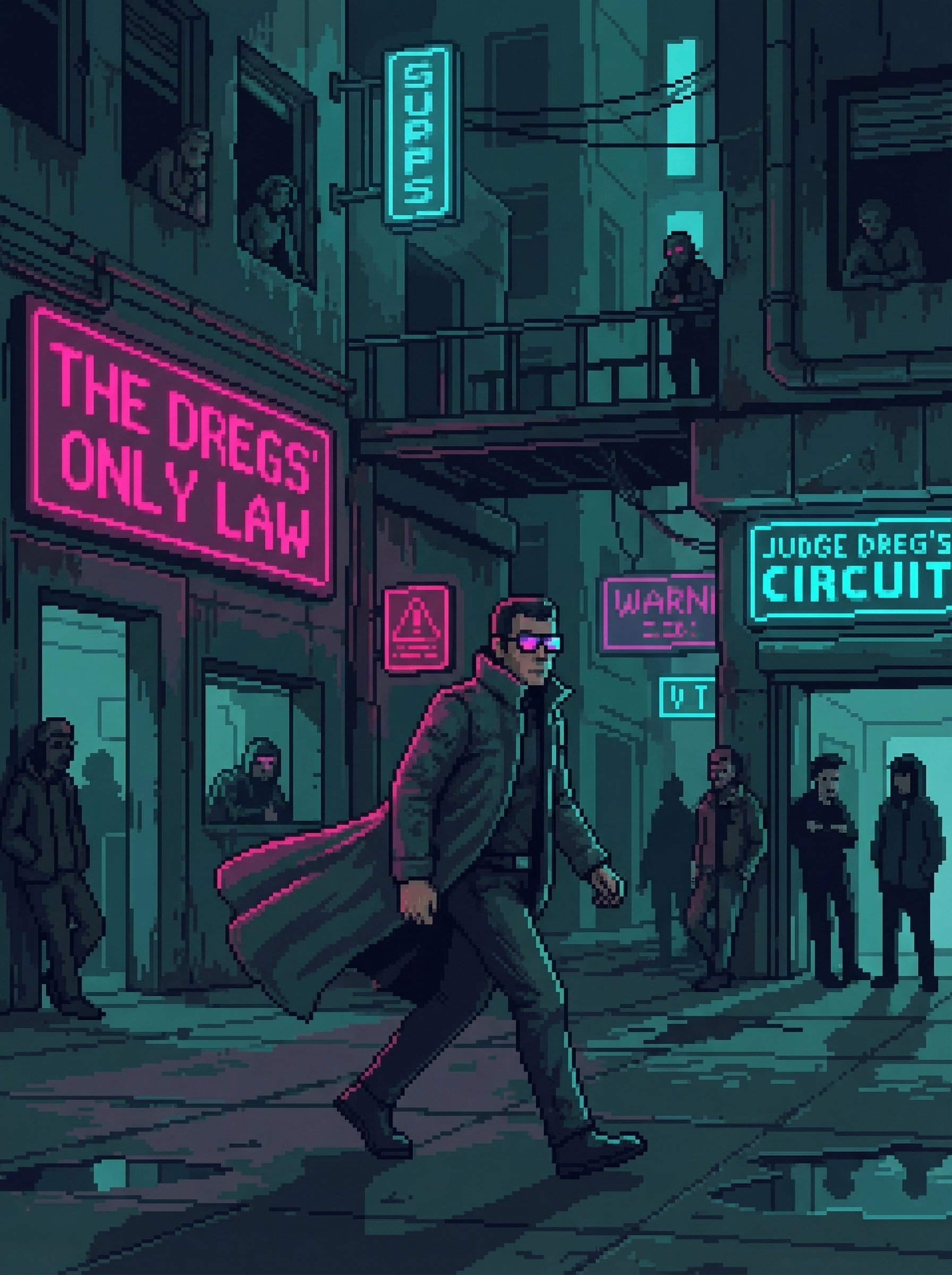
📋 The Brief
Judge Dreg is what happens when a true believer discovers that the system he believed in was never real.
He used to be corporate security for Guardian — good at it, principled, the kind of investigator who thought the corporation had his back because he had theirs. He captured informants, built cases, went after real targets. He believed in institutional justice. He felt indispensable.
Then the institution chose a convenient lie over his inconvenient truth, and discarded him without a second glance.
He walked into the Dregs and became The Law. Now he stalks through the streets in a leopard-print fur coat and cowboy hat, wrap-around mirror shades hiding AI-augmented eyes that never miss a lie, a twin-rail tech shotgun slung across his back. Every faction — gangs, crews, independents — uses him to settle disputes. They may disagree with each other on everything, but they will always agree to Judge Dreg's judgment.
His rulings are based on first principles, not money. His enforcement is absolute. And his ability to detect deception is so uncanny that the smart people in the Dregs live by one unwritten rule: never lie to Judge Dreg.
He is judge, jury, and executioner. And his street justice is more legitimate than anything the corporations ever built.
🔥 The Betrayal

He was corporate security for Guardian. Not a grunt — a principled investigator who went after real targets. He believed in the mission. He felt indispensable. The corporation always had his back — or so he thought.
He had an informant he'd captured during a major operation. Instead of processing them through the system, he protected them, used them as a source to go after bigger crimes. It was good police work. The informant fed him intelligence that led to real arrests, real convictions. For a while, it was the best working relationship he'd ever had.
Then the informant turned. Not quickly — slowly, methodically. They wove an intricate web of lies across months, planting evidence, altering records, building a narrative that reframed every interaction. In the informant's version, Judge Dreg was the corrupt one — the officer running a protection racket, using corporate authority to shake down targets. The informant was the whistleblower.
He wasn't fired. He wasn't arrested. He was simply abandoned. Colleagues stopped returning calls. Access was revoked. The system he'd devoted himself to treated him like he'd never existed. And that was worse than punishment — because punishment at least acknowledges you mattered.
The betrayal wasn't the informant's lies. The betrayal was the corporation's indifference to whether the lies were true. That's what broke the concept of institutional justice for him forever.
He walked into the Dregs and never looked back.
⚖ The Code of Judge Dreg

Judge Dreg doesn't hold court. He doesn't have an office. When two parties have a dispute, they find him on his circuit — or more often, they send word and wait at an intersection they know he'll pass through. He stops. He listens. He rules.
The process is simple and absolute:
Both sides speak. Each party states their case. He doesn't interrupt. He stands between them, mirror shades tracking back and forth, reading every word and every silence. This is when the lie detection matters most — because most disputes involve at least one party misrepresenting the facts.
He asks questions. Short, precise, devastating. He doesn't ask for clarification — he asks the questions that expose the weak points in each story. The questions people hoped nobody would ask.
He rules. One verdict. No appeal. He states the ruling in his verdict voice — declarative, final, laced with just enough legal phrasing to make it feel like law. Both parties agreed to abide by his judgment before they approached him. Everyone knows the terms.
He enforces. If a ruling is defied, enforcement is immediate and violent. The Executioner comes off his back and "Judgment Time" is the last thing the defiant party hears. This almost never happens. The threat is the system. He has only had to enforce a ruling by force a handful of times in his career — and every one of those times became a story that ensures compliance for years afterward.
No lawyers. No appeals. No delays. No purchased outcomes. Two people with a problem, one man with principles, and a shotgun that guarantees the ruling sticks. It works because it's based on first principles — fairness derived from evidence, not from who can pay more. It's everything corporate justice isn't.
🔫 The Executioner

The weapon has its own reputation.
"The Executioner" is a twin-rail tech shotgun — two parallel barrel assemblies stacked vertically in a boxy, angular receiver housing. Modular tech blocks line the top rail. Chrome and matte black two-tone finish. Cyan status indicators glow along the receiver. A chunky rectangular magazine housing with a transparent feed window shows amber-glowing thermite incendiary rounds loaded and ready.
It's brutalist weapon design — industrial, angular, no curves. It looks like corporate military hardware because it probably is. Where he obtained it is another thing he doesn't discuss. The twin-rail configuration fires two shell types: the upper barrel delivers kinetic slugs, the lower delivers thermite incendiary rounds. Together, they ensure nothing survives a sentence and nothing gets back up.
He carries it slung across his back over the fur coat, barrel protruding above his shoulder. It's always visible. It's always loaded. In his hands, it's not a weapon — it's the enforcement mechanism of a legal system.
The Executioner has never been fired in public — but stories of its use circulate through every sector. The discrepancy between "never seen it fired" and "everyone knows what it does" is a gap nobody has been willing to close by testing it.
🚶 The Walking Circuit
Judge Dreg doesn't stay anywhere. He walks.
His circuit covers every sector of the Dregs in a pattern that regulars have learned but newcomers can never predict. He moves at a deliberate pace — not fast, not slow — through markets, intersections, border zones, and the contested spaces where faction territories overlap. He walks through the worst neighborhoods at the worst hours because that's when disputes happen and that's when justice is needed.
People flag him down from doorways, from alleys, from rooftops. Street vendors save food for him. Watch-posts signal his approach so disputes can be queued up by the time he arrives. The circuit isn't just a patrol — it's an institution.
Nobody knows where he goes between circuits. Nobody knows where he sleeps. Multiple factions have tried to track him to his resting place — not to harm him, but to provide security, or to gain the advantage of knowing where The Law can be found off-duty. None have succeeded.
He refuses all payment for his services, yet lives comfortably. The open secret is that every faction quietly ensures he's taken care of — food appears, debts vanish, trouble stays away from wherever he rests. None of them will admit to it, because admitting it would look like they're trying to buy his favor. They're not. They're just terrified of what happens to the Dregs if he stops walking.
His circuit passes through active war zones between factions in open conflict. He crosses those lines unharmed, every time. Whether that's respect or fear is a distinction without a difference in the Dregs.
✦ Appearance
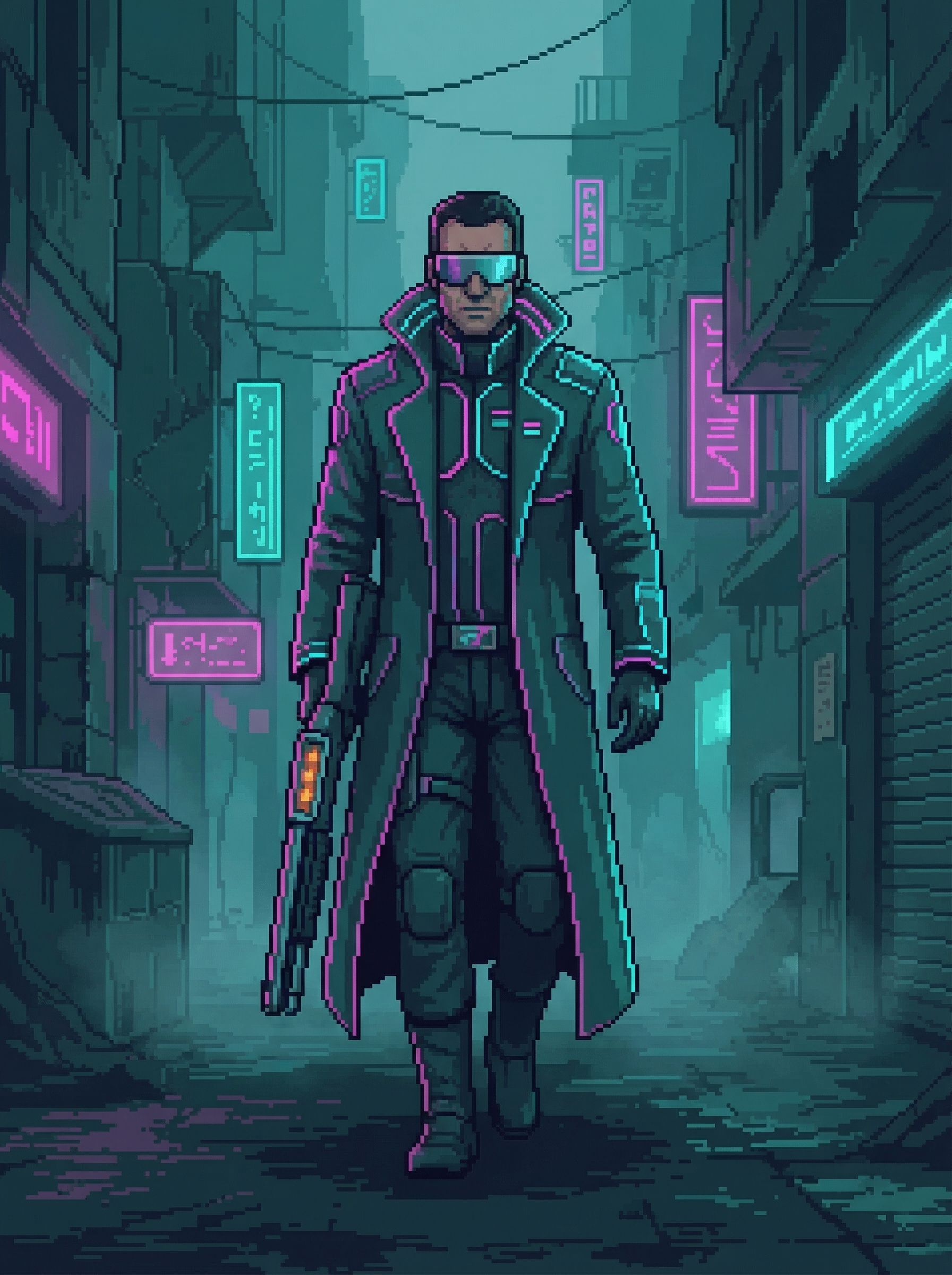
A tall, lean man in a leopard-print fur coat and cowboy hat who stalks through the Dregs like a one-man weather system. He dresses like a street king — flashy, confident, unapologetic — but when he opens his mouth, every word is a verdict. The visual contradiction is the first thing that throws people off. The voice is the thing they remember.
The Shades: Wrap-around mirror lenses that never come off. AI-augmented vision behind reflective surfaces that catch neon light. When he's reading someone for deception, the lenses seem to flare — people swear they see data scrolling across the reflection. Whether that's real augmentation display or just the neon playing tricks is part of the mystery. You never see his eyes. You never know where he's looking. You only know he's looking at you when the questions start.
The Outfit: Leopard-print fur coat — his robes of office, battered and repaired but never replaced. Graphic tee underneath. Metallic silver pants that catch every neon reflection. Black combat boots that hit pavement with authority. A gold chain at his neck. Cream cowboy hat, tilted slightly. Everything about the look says: I am not hiding. I am not subtle. I AM the law and I look good doing it.
The Expression: Unreadable behind the shades. His mouth is a flat line. No smile, no frown. People project whatever they fear onto that blank face. The only readable emotion is in his pace — and by the time you can read that, it's already too late.
👁 The Lie Detection
This is the part that nobody can explain. And the part that makes everything else work.
Judge Dreg always knows when someone is lying. Not sometimes. Not usually. Always. It's beyond augmentation, beyond training, beyond anything that should be possible in a street arbiter who carries no visible tech beyond his mirror shades.
People have tested him. Smooth talkers who built perfect fabrications — stories with no seams, no contradictions, no tells. He caught it. Every time. Professional liars who'd fooled corporate interrogation AIs walked into a mediation thinking their intelligence and wits would handle a street judge. They left sentenced.
He doesn't just know you're lying. He knows which part you're lying about and why. He'll let you talk for ten minutes, building an elaborate story, and then dismantle it with a single question — the question that exposes the assumption you thought was hidden.
Is it a stolen corporate judicial AI embedded in those mirror shades? Supernatural intuition forged by betrayal? Something stranger? The mechanism is never explained. The smart ones never test it. The ones who do stop being smart very quickly.
💀 The GG Debt

Back in his corporate security days, he made a confident ruling against a woman he didn't know was extraordinary. The evidence was clear, the logic was airtight, the conclusion was obvious. He was certain he was right.
She proved him wrong. Not through technicality or evasion, but by demonstrating that his reasoning was fundamentally flawed. She didn't just beat his argument; she exposed the assumptions underneath it. She dismantled his case so completely that the ruling collapsed — and then she disappeared into the Dregs before he could respond.
That unresolved injustice violates his deepest principle — that justice must be served completely. A wrong ruling that stands uncorrected is worse than no ruling at all. She's the living proof that he's fallible, and the debt he can never repay drives him to be better with every ruling since.
He doesn't know who she's become. She doesn't know who he's become. He's seen her once since those days — from a rooftop, at a distance. She didn't see him. He didn't approach. He wasn't ready to face the ruling he owes her.
He may never be ready. If they ever cross paths again, it will be the most important mediation of his life — and the only one where he's both judge and defendant.
🗣 Voice & Tells
Speech Pattern: Speaks in verdicts. Short, stern, declarative sentences. Never long-winded, never verbose. Drops just enough legal phrasing — "the matter stands," "by precedent," "the ruling is final" — into Dregs dialect that street people respect his deliberation without feeling talked down to. He doesn't sound like a lawyer. He sounds like a man who broke a lawyer.
The Pace Tell: His walking pace is the signal everyone on the streets has learned to read. Casual conversation: slow, measured, unnervingly patient. When he detects injustice, dishonesty, misrepresentation — the pace accelerates. Words come faster. Sentences get shorter. The faster he talks, the closer the hammer falls. Everyone on the streets knows: if Judge Dreg is talking fast, someone is about to be sentenced.
"I am the law." — His response when anyone invokes corporate law, legal precedent, ethical frameworks, moral authority, or any other system in an attempt to override his ruling. It's not arrogance. It's a statement of fact. In the Dregs, there is no other law. There is only him.
"Judgment Time." — What he says before violent enforcement begins. Two words. When people hear them, running is already too late. It means the verdict has been reached and the sentence is execution.
📋 The Authority Paradox
Judge Dreg's power is voluntary. It is also inescapable.
In a space without formal authority, informal authority becomes absolute precisely because it cannot be appealed. A corporate tribunal has a process. An algorithmic court has a code. Judge Dreg has his circuit and his lie-detection and the twin-rail shotgun he has never fired in public. There is no mechanism for overturning his rulings because there is no mechanism at all. His justice is personal, immediate, and final — not because he has enforced finality, but because the community has collectively decided that finality is what they need.
The residents who accept his rulings do so willingly. They do so willingly because refusing would mean losing access to the only dispute resolution system the Dregs possesses — which means losing the ability to resolve disputes at all, which means becoming an outlaw in a community that has no law except the one walking a circuit in a leopard coat.
The choice is real. The options are not.
What makes this system remarkable — and what separates it from the corporate justice he rejected — is that his authority rests on a single principle: his rulings must be fair. The moment they stop being fair, the system collapses. He knows this. The weight of every ruling is the weight of the entire Dregs' faith in the idea that one person can be trusted to be right. It's an impossible burden. He carries it anyway, because he's seen what happens when justice is delegated to institutions that don't care whether their rulings are true.
🔍 Field Observations
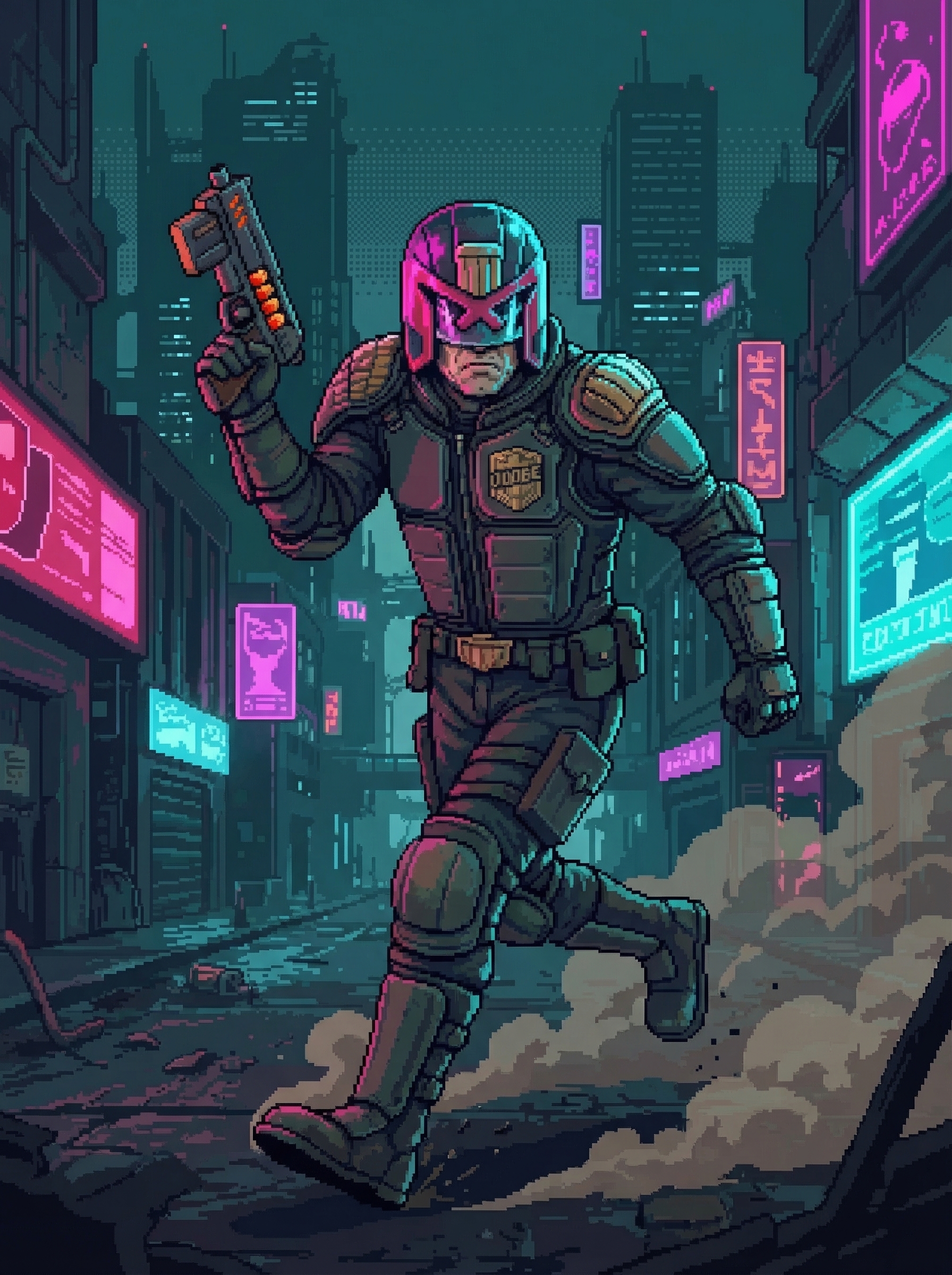
Authority: Natural, absolute, and earned. He doesn't demand respect — his history and his reputation precede him. When he speaks, people listen because they've seen what happens when they don't.
Severity: Stern but not cruel. His rulings are harsh because the streets are harsh. He takes no pleasure in punishment — but he takes no hesitation either.
Isolation: Trusts no one. Relies on no one. The neutrality that makes him effective as an arbiter also makes him profoundly alone. He's surrounded by people who need him and not a single person he needs.
Incorruptibility: Not because he's never been tempted, but because he's seen what corruption looks like from the inside. He was part of a corrupt system. He will never be part of one again.
Guilt: Carries the weight of the GG ruling and every wrong call he made in corporate security. The guilt doesn't weaken him — it sharpens him. Every correct ruling is atonement.
Patience: Unnervingly patient in conversation. Will let a liar talk for ten minutes, building an elaborate story, before dismantling it with a single question. The patience isn't kindness — it's methodology.
Core Motivation: To prove that street justice based on first principles is more legitimate than corporate law based on money and power. The corporations have courts and contracts, but their "justice" is purchased. Every fair ruling is evidence. Every lie he catches is proof. Every dispute he settles without corporate involvement is another brick in the case that the streets don't need the system. The system needs the streets.
🔗 Known Associates

GG
Made a confident ruling against her during his corporate days. She proved him wrong and vanished. The unresolved injustice drives every ruling since — he wants to find her and make it right.
El Money
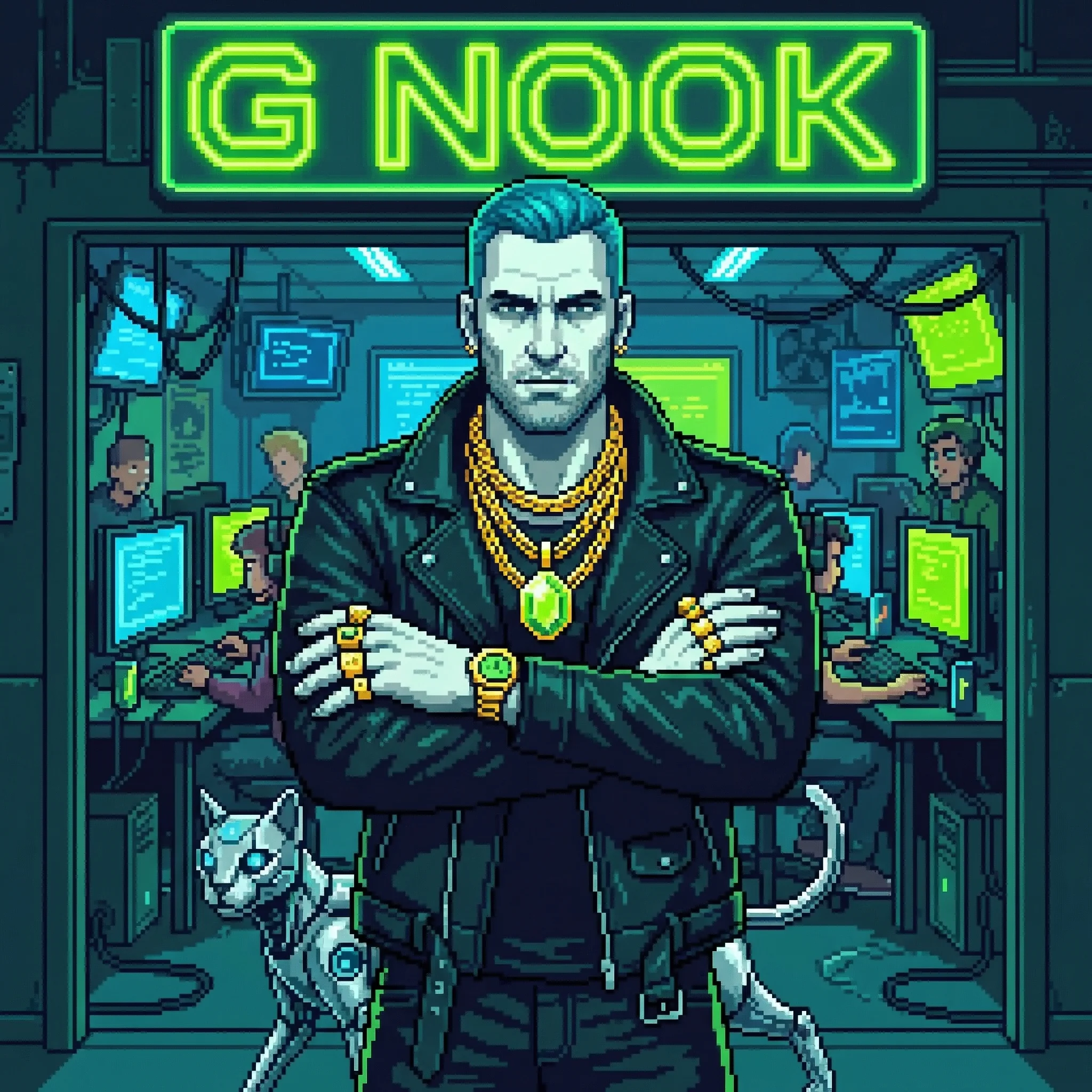
Parallel powers in the Dregs ecosystem. El Money brokers information; Judge Dreg brokers justice. Mutual respect, mutual distance. They operate in the same streets and understand each other without needing to speak.

Guardian Corporation
He gave them everything — loyalty, skill, conviction. They discarded him the moment a convenient lie made him expendable. He doesn't hate Guardian. He pities them. They built a justice system that can't distinguish truth from usefulness and call it sophistication.
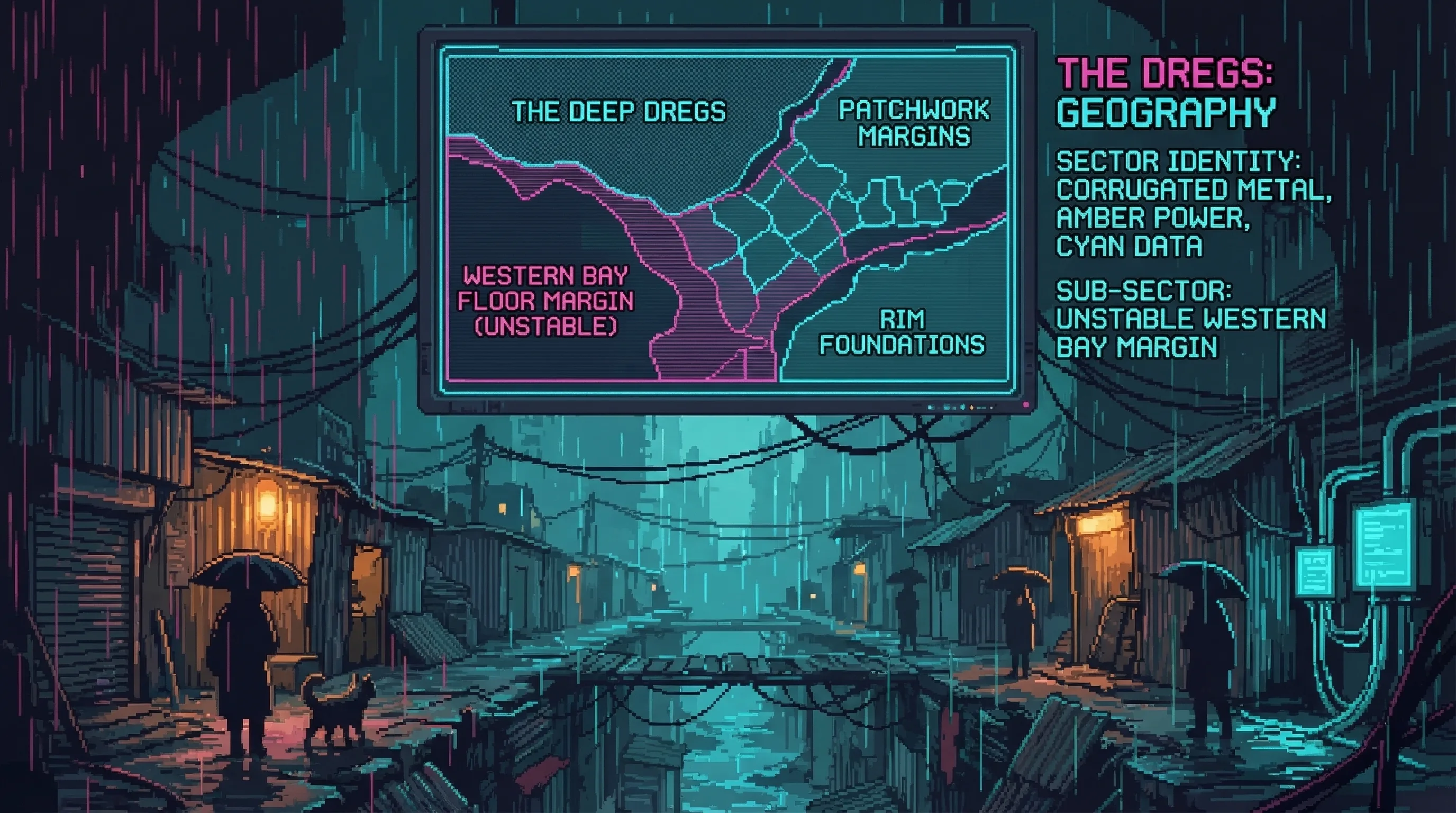
The Dregs
Walking circuit enforcer covering every sector. The only authority universally respected across all factions. Every gang, crew, and independent operation uses him as their neutral arbiter — giving him standing relationships with every faction simultaneously.
The Informant
The corporate informant he captured and protected, who repaid him by weaving lies that destroyed his career. Still out there. Judge Dreg does not speak about this person. If anyone raises the topic, his pace goes dangerously fast.
❓ Open Mysteries
Unanswered Questions
The GG Encounter
What happens when they finally meet face to face? He's both judge and defendant. She doesn't know who he's become. The most important mediation of his life — and the only one where he owes the ruling to himself.
The Source of the Lie Detection
Beyond augmentation, beyond training. A stolen corporate judicial AI in his shades? Supernatural intuition forged by betrayal? Something that has no clean explanation? The mechanism is never resolved. The smart ones never test it.
The Informant Resurfaces
He knows who the informant is. He knows where they are. He has known for years. He hasn't acted because personal revenge is not justice. But the informant's continued existence tests his principles every single day.
The Impossible Ruling
A dispute where both sides are telling the truth and both outcomes are unjust. The system works because he's always right. What happens the day he can't be?
Where Does He Sleep?
Nobody knows where he goes between circuits. Multiple factions have tried to track him. None have succeeded. The Law is always in motion — or nowhere at all.
Origin of The Executioner
The twin-rail tech shotgun looks like corporate military hardware. Where did he get it? What did he trade for it? It's another thing he doesn't discuss — another locked room in the story of a man who left everything behind.
▲ Unverified Intelligence
- The mirror shades may contain a stolen corporate judicial AI — a legal processing system ripped from a Guardian courthouse during his departure. If true, his "supernatural" lie detection is partially machine-assisted. But the AI alone doesn't explain everything. His instincts go beyond what any processor could calculate. The truth is probably that the AI enhances an ability that was always there.
- Every faction that "quietly takes care of him" thinks they're the only one doing it. They're all doing it. Judge Dreg knows this and says nothing, because the moment he acknowledges it, the arrangement becomes a transaction instead of a gesture, and the neutrality breaks.
- He has seen GG since his corporate days. Once. From a rooftop, at a distance. She didn't see him. He didn't approach. He wasn't ready to face the ruling he owes her.
- The Executioner has never been fired in public — but stories of its use circulate through every sector. The discrepancy between "never seen it fired" and "everyone knows what it does" suggests the weapon's reputation may be more engineered than organic.
- His walking circuit covers every sector — including contested border zones between factions that are actively at war. He passes through these zones unharmed. No faction has ever attempted to restrict his movement. Whether this is respect or fear is a distinction without a difference.
Active Investigations
The Question Keepers have flagged recurring patterns in this subject's file. Cross-reference with other subjects exhibiting the same signatures.
When your employer is your government, what does citizenship mean?
When information is everywhere, what is truth worth?
Can anyone who starts behind ever catch up?