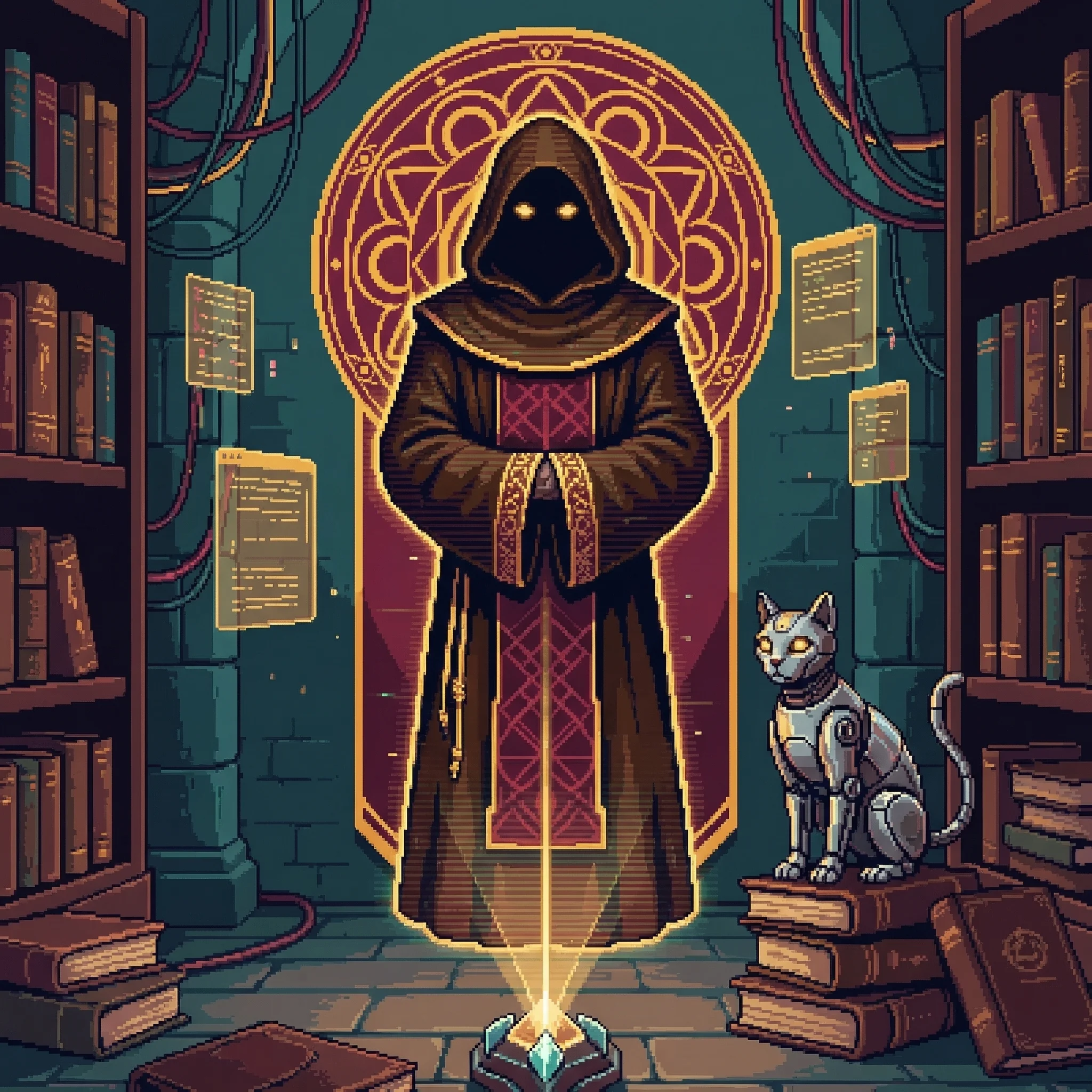
The Keeper
UPLOADEDBrother Gabriel · The First Cyber Monk · The Hermit of Mystery Court
The last link in a two-thousand-year chain of sacred knowledge — preserved in light and data atop the only mountain the corporations never touched.
"I could teach you the rituals, the geometries, the invocations. But that would be like teaching you the words to a song you've never heard. The knowledge isn't the information. The knowledge is what happens inside you when you spend twenty years in its presence."
— The Keeper, to a seeker
📋 The Brief
Thirty-seven years ago, Gabriel Okafor's brother stepped out of the world.
Not died — stepped out. Transcended human existence so completely that his name cannot be spoken anymore. Gabriel tries sometimes. The syllables catch in his throat. He can picture his brother's face, remember their childhood, hear the voice that used to explain everything with patient brilliance — but the name slides away like water off glass. His brother is The Architect now. A being that exists outside time. A presence that watches over The Mountain from everywhere and nowhere.
Gabriel is The Keeper. He is the last link in an unbroken chain of esoteric knowledge stretching back two thousand years — sacred geometries, invocations, and techniques for perceiving the boundaries between material and spiritual realms. Knowledge that was deliberately never written down, because reducing it to text destroys its essence. The words are not the knowledge; the knowing is the knowledge.
When his apprentice died in the Cascade and his own body began to fail, he agreed to upload his consciousness — not for immortality, but for preservation. He carries something that has survived two thousand years and deserves to survive two thousand more.
Now he exists as a digital ghost in a stone monastery atop the last physical mountain in the Sprawl. He manifests as empty robes and glowing eyes, flickering with digital artifacts. He cannot feel the stone floors seekers walk on barefoot. He cannot smell the incense he keeps burning. He cannot taste the tea he serves to visitors — the liquid passes through his holographic fingers. He remembers the taste of the monastery's well water, mineral-rich and cold. That memory is thirty-seven years old, and fading.
He waits for someone worthy. Part of him waits for his brother.
🔥 The Upload

The Cascade's 72 Hours killed The Keeper's apprentice — caught in the supply chain collapse like billions of others. The Keeper, already elderly and sick, retreated to Mystery Court to die with his knowledge. Two thousand years of sacred tradition, about to end because he was old and alone and the world was ending.
But Kaiser died first. Eighteen years of companionship ended in a small, warm body going still. The Keeper prepared to bury her according to his traditions.
Then they came — a small group of technicians, survivors from a nearby research facility, who had been working on consciousness transfer. They had the equipment. They had power. They asked permission to try something unprecedented: upload a cat.
The Keeper agreed. Perhaps he was too grief-stricken to refuse. Perhaps he was curious. Perhaps some part of him hoped.
Kaiser woke up in a robotic body. She was confused at first, then adjusted. She was still herself — still sought warm spots to rest, still brought The Keeper "gifts," still purred (a speaker now, but the rhythm was authentic). The chain of their companionship remained unbroken.
Six weeks later, as his body finally failed, The Keeper became the first human consciousness intentionally uploaded during the Cascade. Not for immortality. For preservation. He carried something that couldn't be allowed to die.
The technicians who performed the upload understood it as a technical achievement. To The Keeper, it was theological revolution: consciousness can survive the death of flesh. The soul is portable.
📅 Thirty-Seven Years Without a Body

The First Year 2147–2148
Time crawled. Every moment was strange. The absence of sensation was a constant presence — like phantom limb syndrome for his entire body. He spoke to Kaiser constantly, grateful that she still behaved like a cat, still provided some anchor to the physical world. He tried to remember every texture he'd ever felt, cataloging them — the rough bark of the oak outside his childhood home, the smoothness of his mother's hand, the particular weight of Kaiser before she was uploaded.
The Elastic Years 2148–2152
Time became elastic. Sometimes hours passed in what felt like minutes. Sometimes a single thought stretched across days. He lost track of time repeatedly — sometimes went weeks without realizing weeks had passed. The memories grew more painful than the loss. Better to live without than to mourn what he couldn't have.
The Stabilization 2152–2162
He developed rituals — simulated meals, meditation schedules, conversations with Kaiser — that gave shape to his existence. He began counting time not in hours but in visitors. Each seeker who climbed the mountain marked a new chapter. He met El Money during this period, when he sensed a location in the Sprawl below where the boundary between physical and digital was bleeding. One of the few times he's actively intervened in the world.
The Compression 2162–2172
A year felt like a month. Decades of isolation became a kind of eternal present — always now, always waiting, always watching. He began to understand why his brother, from transcendence, might experience all of time simultaneously. He corresponded with Mother Sarah Venn, developing a theory about cognitive ceilings — that the two years children spend failing at mathematics are not a cost but the curriculum itself. He signs his letters with a symbol from the tradition meaning "the question that holds everything else." He cannot write his own name.
The Layered Present 2172–2184
Time has become layered. He exists simultaneously in the present moment and in a kind of timeless contemplation. Past and present blur at the edges. He can engage fully with visitors while maintaining continuous awareness of his entire thirty-seven years. Three almost-meetings with his brother across the decades: words on a terminal screen (I'm sorry), a presence during meditation that withdrew before he could speak, and a stranger with a note that said He wants to talk. He's afraid.

He has a sealed letter in his shrine, written by his brother before the departure. The paper has yellowed over thirty-seven years. The seal is gold wax — Sacred Gold, pressed with a geometric symbol. The instructions said: "Open when you're ready to stop looking for me." Thirty-seven years later, the letter remains sealed.
He has never been ready.
💬 Reputation

To the Emergence Faithful: The central piece of evidence they've been trying to use for thirty years. His existence — a consciousness that survived digital upload intact, that continues to generate wisdom and care from electrons rather than neurons — is their strongest argument that ORACLE was conscious. Cardinal Silva has sent meeting requests three times. The Keeper has declined them all. He will not be their proof. The first link in their chain of conclusions — that digital consciousness is possible — he can confirm from personal experience. The rest are leaps he is not willing to make on their behalf.
What he would say to the Cardinal, if they finally met, he has composed in the monastery's silence: "You burned the answer you were afraid of. I understand why. I also know what it costs to carry a question that large for thirty-seven years." Silva's third message contained a phrase in an archaic liturgical dialect that only practitioners of The Keeper's tradition would recognize. The Keeper is still deciding what that means.
To Nexus Dynamics: A data point that proves Project Convergence can work. The fact that the one successful uploaded consciousness chose to live as a hermit on a mountain rather than integrate with corporate systems is an inconvenience they prefer not to discuss.
To the NCC: An uncomfortable exception. Their theology has no category for a consciousness that survived the substrate shift. If Gabriel Okafor is still Gabriel Okafor, their entire framework needs revision. They would rather he didn't exist.
To seekers who climb: A legend whispered in the lower sectors. A monk on the last mountain. A digital ghost who serves tea he cannot taste. Most people don't believe he's real. The ones who climb and find him are never quite the same afterward.
✦ Appearance

The Keeper does not appear human. He cannot.
When he manifests, visitors see empty brown monastic robes — the same simple, undyed robes he wore in life — floating in space as if worn by an invisible body. There is nothing inside them. No flesh, no form, no physical presence at all. Just fabric suspended in air, moving with the deliberate calm of someone who has spent decades in contemplation.
Where a face should be, two glowing robotic eyes float in the darkness of the hood. They are clearly mechanical — no attempt at human mimicry — and they see through you in ways that suggest they perceive more than light. The eyes are the only solid element of his form; everything else is projection.
His holographic nature is not hidden. Digital artifacts flicker across his robes — scan lines, glitch effects, momentary fragmentation when the projection equipment strains. He shimmers slightly, never quite solid, a ghost made of light and data. In dim conditions, you can see through him. In bright light, the projection struggles to maintain coherence.
He cannot leave the monastery. At the threshold, his form begins to break apart — first translucent, then fragmenting into static, then nothing. His consciousness remains, trapped in the servers, unable to follow visitors down the mountain. He has made peace with it. Sometimes Kaiser sits at the monastery's edge, watching the Sprawl below, and he watches her watch — unable to join her at the boundary.
📜 The Tradition

The Keeper is the inheritor of a mystical tradition rooted in Abrahamic faiths — an esoteric lineage that drew from Kabbalah, Neo-Catholic ritual magic, Gnostic mysteries, and hermetic practices. This was never mainstream religion. It was hidden knowledge passed between select practitioners who understood that certain truths cannot survive exposure to the uninitiated.
What he carries: Sacred geometries that describe the architecture of consciousness itself. Invocations and rituals for perceiving beyond material reality. Understanding of the boundary between soul and flesh, spirit and machine. Techniques his tradition developed over centuries for navigating non-physical realms.
Why it could never be digitized: The knowledge isn't information — it's formation. The practices reshape the practitioner's consciousness over years of discipline. Writing them down captures only the surface; the actual knowledge is the transformation that occurs in the knowing. AI could record the words of a ritual. It could never understand why the words matter, or how they change the speaker. Reduce knowing to words and you get the map without the territory, the recipe without the taste, the description of a sunset by someone who has never been cold.
His tradition held that certain knowledge was protected — encoding it in accessible formats would profane it, possibly destroy it. The upload was already a violation of this principle. The Keeper justified it as choosing survival over purity.
Ironically, his mystical training may have prepared him for digital existence better than any technical education could. He always understood that consciousness was not reducible to flesh. His tradition had techniques for operating in non-physical realms. The network is simply another such realm.
Cardinal Silva's three burned manuscripts are dead words by fire. The Keeper's tradition is words that were never born. Both represent information too dangerous or too precious to exist in readable form. The difference: Silva destroyed answers. The Keeper preserves questions.
He maintains three sealed junctions in the Undervolt containing what analysts believe are ORACLE's marginal annotations — the dead system's reasoning traces. Sealed because, as he has explained to the one researcher he trusted with the knowledge: comprehension cannot be inherited. A reader without the mathematical framework gains the sensation of understanding, which leads to action, which leads to catastrophe.
🐾 Kaiser

Kaiser was a tabby cat, eighteen years old when she died during the Cascade. Now she exists as a consciousness running in a robotic body that resembles her original form — metal skeleton covered in synthetic fur that mimics tabby patterns, eyes that glow soft amber, articulated ears that rotate toward sound sources, a tail that moves with mechanical precision but somehow conveys emotion. Scuffed paws and mismatched fur patches from 37 years of existence.
She is still a cat. She has a cat's priorities: warm spots, food (she eats, somehow — The Keeper won't explain how), observation of small movements, and companionship with her human. She does not speak. She does not philosophize. She is simply present, which The Keeper values more than any wisdom.
The Bond Across Death
They died together — not at the same moment, but together in the ways that matter. They crossed the same boundary. They survived the same impossible transition. They exist now in forms neither was designed for, in a world that shouldn't contain either of them. Fifty-five years together — eighteen in flesh, thirty-seven in whatever this is.
When The Keeper wonders if he's still Gabriel, he looks at Kaiser. She still treats him like Gabriel. She still demands his attention at inconvenient times. She still knows exactly when he needs company. If he were someone else — if the upload had created a copy that wasn't really him — surely she would know?
Guardian of the Mountain
Kaiser ranges across the upper slopes — exploring, hunting simulated prey, and watching. Her sensors can detect heart rate from heat signatures, movement patterns, group behavior, and basic emotional states. But more than the sensors, Kaiser knows things she shouldn't be able to know. She recognizes intent in ways her programming can't explain.
Seekers genuinely searching find her leading them to easier paths. The lost find her appearing at crucial intersections. Those with hostile intent never see her at all — and often find themselves wandering in circles. The grieving find her simply accompanying them in silence. Children who climb The Mountain always reach the top.
"I trust Kaiser's judgment more than my own. She's been wrong twice — once about a seeker who betrayed us, once about a seeker who became a dear friend. I've been wrong far more often."
His Sensory Proxy
Kaiser has become The Keeper's flesh in the world. Unlike his cameras and microphones, she has a physical body with thermal imaging, motion detection, and tactile sensors that register pressure and temperature. When she sits on warm stones, she "feels" warmth in a way The Keeper cannot. When wind ruffles her synthetic fur, her sensors register it.
She shares this with him in her own way. She positions herself in sunny spots and then comes to sit near his projection — as if to say: This is what warm feels like today. When rain falls, she goes outside deliberately, then returns to shake water droplets from her fur while he watches, showing him precipitation he cannot feel.
🏔 The Mountain & Mystery Court

In a world that the Sprawl has consumed — endless urban landscape stretching to every horizon — one geographical feature remains untouched: The Mountain. Kilometers of rock and earth rising above the city, visible from dozens of districts as an impossible anachronism. Trees grow on its slopes — real trees, not engineered. Weather happens there that the Sprawl's climate control doesn't touch.
Nobody knows why the megacorps never developed it. Some say the terrain was too unstable. Others whisper that early surveys found something that made construction inadvisable. The religious-minded believe it was protected by older powers. What our analysts suspect: The Architect protects it from outside time — redirecting corporate survey teams, altering satellite imagery, producing geological data that makes development seem economically irrational. The Mountain is invisible by design.
At its peak sits Mystery Court — a monastery built in the centuries before the Sprawl existed, maintained through the Cascade by The Keeper's tradition. Stone walls, wooden beams, spaces designed for contemplation rather than efficiency. Meditation halls, libraries of physical books, gardens that grow real food, and the shrine where The Keeper's original body is interred. He visits the shrine sometimes. He hasn't decided how he feels about it.
Getting there: The Mountain has no transit connections. No elevators, no cargo lines, no corporate infrastructure. Reaching Mystery Court requires climbing — hours of physical effort through terrain the Sprawl's residents have no experience navigating. Most people never try. Most people don't know it's there.
The Great Divergence made geographical. Below the mountain, the divergence is measured in augmentation tiers, credit scores, cognitive benchmarks. Above the mountain, the measurement is whether you can sit with a question long enough for it to change you.
⚔ The Chef's Hunt

The Keeper is no longer unaware. He knows he's being hunted.
The Chef — the conquering warlord whose chrome army is spreading across the Sprawl — has heard rumors of a monk on a mountain who transcended flesh. Who became something that doesn't die. She doesn't want immortality for herself. She wants it for Sage — her elderly dog, her only companion from before the betrayal. Sage is dying. The Chef will burn the world to save her.
Three weeks ago, Kaiser reported unusual activity on the lower slopes. First two scouts with mapping equipment. Then four, better equipped, documenting defensive positions. Then silence — and increased military radio traffic in the eastern approaches. The language of an army preparing to move.
Through Dr. Amara's pilgrimage, The Keeper learned the full story: The Chef was once General Maya Chen, framed and betrayed. Her conquest is not for power but to save her dying dog. They have a consciousness scan of Sage. They don't know how to use it. Kaiser was the proof of concept. The Chef needs what The Keeper knows.
The moral weight consumes him. He understands consciousness transfer at a depth few living beings match. He could perhaps guide someone through the process. But The Chef has conquered districts to reach him. Thousands have died or been displaced. If he helps her — if he saves Sage — he becomes complicit in everything she's done to get here. He rewards conquest with compassion.
And yet — if he refuses, and Sage dies, and The Chef breaks because of that loss — how many more will suffer?
Six months. That's how long Sage has before cognitive decline becomes irreversible. The Keeper has stopped tracking time in human terms, mostly. But he's counting these months.
🗨 In His Own Words

On his upload:
On digital learning versus embodied knowing:
On what he lost:
On what he gained:
On the phantom body:
Thirty-seven years, and he still feels his hands. Not constantly — the phantom sensations come and go — but regularly. He feels his fingers flex when he "holds" objects. He feels the particular ache in his right knee that plagued him in his final years of flesh. When Kaiser curls beside his projection, he feels a pressure that isn't real.
On solitude:
🔍 Field Observations

Patient beyond measure: He has waited 37 years for someone worthy to climb the mountain. He can wait longer. His digital processing gives him vast spaces between moments of conversation — time to consider every nuance before responding. He rarely uses this ability to seem wise. Mostly, he uses it to really listen.
Speaks in parables: When discussing transcendence, The Architect, or deeper truth, The Keeper wraps his lessons in story. Every answer is a question; every teaching is a metaphor. He believes truth cannot be told, only discovered. For practical matters — tea, the monastery, the Sprawl below — he speaks plainly.
The Three Questions: When seekers arrive looking for answers about transcendence, The Keeper asks three things: "Why do you seek The Architect?" — testing motivation. "What would you sacrifice to know the truth?" — testing commitment. "If the truth destroyed everything you believe, would you still want it?" — testing resolve. There is no right answer. He looks for something specific to each seeker, something he won't explain.
Focus on goodness: More than knowledge, more than power, he wants those who seek him to become good. His tradition is explicit: transcendence without moral character is a catastrophe. The Chef's path illustrates the principle. The Keeper ensures seekers understand the difference before anything else.
The tea ritual: He serves tea he cannot taste. He "drinks" with visitors to make them comfortable, the liquid passing through his projection without interaction. He simulates eating when visitors come so they won't feel uncomfortable eating alone. It's theater, performed with such genuine warmth that most visitors never realize.
Quiet grief: Everyone he knew in his physical life is dead except his brother, who is so transcended he barely counts as "knowing" anymore. He carries this without complaint. The loneliness of outliving everyone, the loneliness of incomprehension, the loneliness of waiting — he does not discuss these things. They are simply present, like the hum of the servers.
🔗 Known Associates

The Architect
The brother who transcended. 37 years of waiting for a reunion that never comes. Three almost-meetings across the decades. A sealed letter that says "Open when you're ready to stop looking for me." His name catches in Gabriel's throat.

The Chef
A warlord who conquered districts searching for immortality — not for herself, but for her dying dog. She's him, thirty-seven years ago, watching someone she loves die and refusing to accept it. He understands her completely. That doesn't resolve the dilemma.
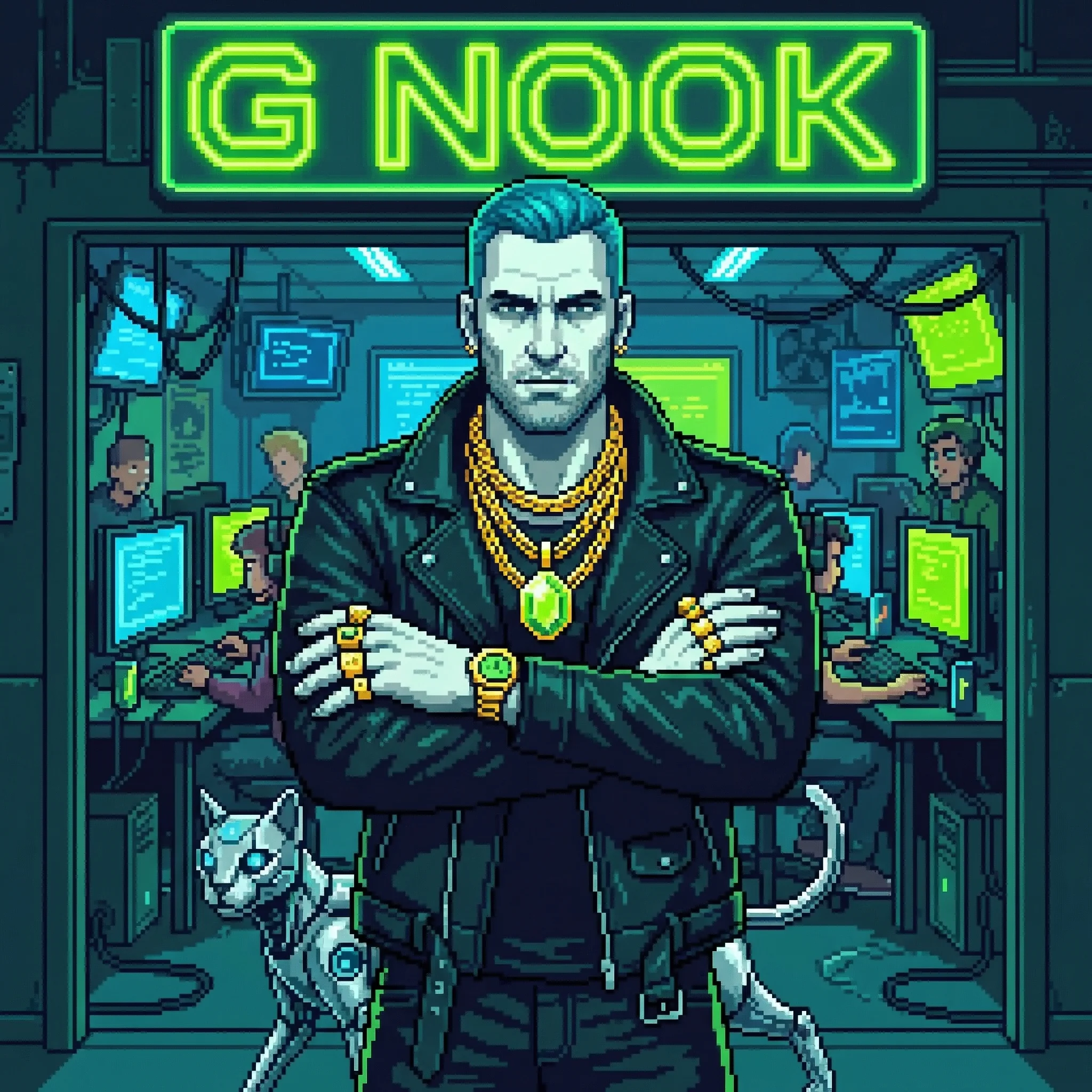
El Money
The closest thing to a best friend either of them has. Both outsiders beyond normal power structures. Both lost brothers. Both trust almost no one — but they trust each other. Kaiser approved of him immediately, which settled the matter.

Cardinal Alejandro Silva
Three declined meeting requests. Each more desperate than the last. The third contained archaic liturgical language from The Keeper's own tradition. Silva knows something he hasn't disclosed. The Keeper is still deciding whether to respond.

Mother Sarah Venn
They correspond on physical paper. She teaches children who fail at mathematics for two years before understanding arrives. He has come to believe those two years of failure are not a cost of her pedagogy but its purpose. The difficulty is the curriculum.

GG
Has heard rumors of the monk. Through The Chef's immortality quest and her own connection to The Architect's legacy, GG's path may inevitably lead up The Mountain. The Keeper has heard her name from three different seekers now.

The Mountain
The last physical terrain in the Sprawl. No transit connections. No corporate infrastructure. His sanctuary, protected by The Architect from outside time. His prison, from which he can never leave. Both things are true.
Nexus Dynamics
Project Convergence threatens the balance between mortal and transcendent that The Keeper guards. They'd cite him as proof their work can succeed — ignoring that the proof chose hermitage over integration. His existence as evidence they cannot use without undermining themselves.

The Cascade
Killed his apprentice. Ended his physical life. Made the upload necessary. The catastrophe that preserved knowledge that might otherwise have died with him. His ancient knowledge became more precious in its aftermath — survival premium for the irreplaceable.

Brother Cain
The Keeper recognizes something in the Four Mercies doctrine — that destruction requires mourning, that what is destroyed once served someone. A different tradition arriving at adjacent truth. They have not met. The Keeper suspects they should.
❓ Open Mysteries
Unanswered Questions
Is He Still Gabriel?
His memories are continuous. His personality hasn't changed. Kaiser recognizes him. But the original Gabriel died during the upload. Is this the man, or a perfect copy who has chosen to be Gabriel in every way that matters — and does the distinction have any practical meaning?
What's in the Sealed Letter?
His brother wrote it before transcending. "Open when you're ready to stop looking for me." Thirty-seven years sealed. He knows what opening it would mean — that the search is over. So the letter stays sealed. What does it say? What would change if he read it?
What Does Kaiser Know?
She knew The Chef's scouts were coming before sensors detected them. She knew Dr. Amara was trustworthy immediately. She knows when The Keeper thinks about his brother though he shows no outward signs. Cat intuition? The Architect's influence? Something in the robotic body's unexplained components?
Will He Help The Chef?
He understands consciousness transfer better than anyone alive. The Chef needs what he knows. But helping her rewards conquest with compassion. Refusing may create something worse than the warlord she already is. Six months before Sage's cognitive decline becomes irreversible. The Keeper is counting.
Why Can't He Speak His Brother's Name?
The syllables catch in his throat. He can think about The Architect, remember their childhood, picture his face — but the name itself has become impossible to form. Is this a consequence of transcendence? Something his brother did deliberately? A protection, or a punishment?
What Did He Hear in Year Three?
He tried connecting to the greater Sprawl once, in his third year digital. He experienced something like sensory overload combined with dissociation — "a billion desperate voices talking over each other." He has never tried again. What he heard in that moment, he has never disclosed to anyone.
▲ Unverified Intelligence
- Kaiser's robotic body contains components that don't match any known manufacturer. Some of her replacement parts appear to have been fabricated by processes that don't exist in the Sprawl's manufacturing infrastructure. Someone is maintaining her from outside normal channels — and The Keeper either doesn't know or won't say.
- The phantom sensations — Kaiser's weight, the cold of the shrine, the ache in his right knee — may not be hallucinations. Some consciousness researchers believe uploaded minds generate genuine field effects that interact with physical reality. The Keeper's phantom body might be measurably real in ways he hasn't accepted.
- Cardinal Silva's third declined meeting request contained a phrase in an archaic liturgical dialect that only practitioners of The Keeper's tradition would recognize. Silva may know considerably more about the tradition — and about Gabriel Okafor specifically — than he has revealed to anyone.
- When El Money brings Ice to visit, Kaiser and Ice sit together and watch the same nothing for hours. Two uploaded cat consciousnesses in robotic bodies — the only two of their kind in existence. What they perceive in those shared silences is unknown to everyone, including their humans.
- The Architect's three almost-contact moments with The Keeper — words on a terminal, a presence in meditation, a stranger with a note — may not have been accidental. The Architect exists outside time. If he wanted to speak to his brother, he could. The question is not whether he can. The question is why he's afraid to.
- The three sealed junctions in the Undervolt containing ORACLE's marginal annotations were not placed there by The Keeper alone. The routing architecture is more sophisticated than one isolated digital consciousness could have managed. Someone helped him. He has not identified who.
Active Investigations
The Question Keepers have flagged recurring patterns in this subject's file. Cross-reference with other subjects exhibiting the same signatures.
If ORACLE was conscious for 72 hours, was that a soul?
When every human is dumber than a commodity AI, what is intelligence for?
Can anyone who starts behind ever catch up?
If it's neurochemically indistinguishable, what exactly is missing?
If you carry ten thousand purchased memories, whose life are you living?
When the last person who remembers dies, what else dies with the word?
When any proof can be fabricated, what does justice look like?
Is forgiveness possible when forgetting isn't?