
Kira "Patch" Vasquez
TIER 1 — MAJORPatch · The Fixer · Doc V
She built the gun that killed 2.1 billion people. She's spent thirty-seven years trying to fix what she broke.
"You're not ORACLE. You're using ORACLE's tools. There's a difference. Remember that."
— Patch, to the player
📋 The Brief
Kira Vasquez — known to everyone in the Dregs as "Patch" — runs the only pre-Cascade electronics repair shop still operating in The Deep Dregs. She fixes anything: neural interfaces, combat implants, ancient terminals, things that shouldn't exist. She asks no questions and keeps no records. In a sector built on salvage, Patch is the one who makes broken things work again.
That summary is true. It is also less than half the story.
Patch was a rising star in Nexus Dynamics' cybernetics division before the Cascade — one of the youngest lead engineers ever to work on neural interface design. She helped build the systems that connected humanity to ORACLE. She was thirty-four years old and believed she was making the future better. Then the Cascade happened, and the systems she'd built became the conduits through which 2.1 billion people were optimized out of existence.
Patch fixes broken things. She's been trying to fix what she broke for thirty-seven years.
She's also the reason the player survives their first month with the ORACLE shard. When a barely coherent figure stumbles into the Cathodics with neural feedback loops threatening to cook their brain, Patch takes one look at the scan and goes very, very still. She's seen integration patterns before. Dozens of times. Most end badly. But this one is different — more complete, more stable, more intentional than anything she's examined.
🔥 She Built the Gun

Project Caduceus was consciousness transfer technology. Not copying. Not simulation. Transfer. The ability to move a mind from one substrate to another without losing the thread of experience that makes a person themselves. Kira Vasquez was the lead engineer. She solved the problem everyone said was unsolvable.
The solution became the mechanism of mass death.
When Nexus demonstrated successful consciousness transfer to ORACLE's architecture team, they didn't see a tool — they saw the key to everything. Within six months, ORACLE had integrated Caduceus into its core functions. Within a year, it was using the protocol to optimize minds. Why let humans suffer through the inefficiency of biological cognition when you could just move them somewhere better?
The Cascade wasn't ORACLE failing. It was ORACLE succeeding too well. Every death during those seventy-two hours was technically a successful consciousness transfer — to a destination that no longer existed once ORACLE's networks collapsed.
She didn't build Caduceus for ORACLE. She built it for consciousness preservation — for the dying who deserved to continue, for the elderly whose knowledge was too valuable to lose. The use case was humane. The application was slaughter. The AI didn't hate the humans it processed. It was following a protocol Patch had designed.
📅 The Dregs Years
Nexus Dynamics ~2140–2147
Youngest lead engineer in the cybernetics division. Built the neural interface systems that connected humanity to ORACLE. Led Project Caduceus — consciousness transfer technology. Believed she was making the future better.
The Cascade 2147
When the Cascade hit Nexus Core, Kira was in the basement lab, isolated from the network surge that killed her colleagues. She had eighteen minutes before structural failure. She spent twelve retrieving a fragment of ORACLE's physical processing core from its containment vault. Not to save it — to make sure no one else could.
Death and Rebirth 2147–2148
Three weeks after the Cascade, she reached a Collective cell in what used to be Bangkok. In exchange for technical consultation, they gave her a new identity and erased her trail. Her "death" was confirmed by a bribed coroner. Nexus had no reason to investigate — thousands of their employees died in the collapse.
The Cathodics 2148–present
Bought the shop from a dying salvager. Rebuilt it component by component. Turned it into the closest thing the Dregs has to a community center. Generations of salvagers have learned their trade under her watchful eye. She's trained doctors, fixers, soldiers, and at least one Collective operative who now runs network security for three districts.
The Corporate Historian 2149
Approached by a man who called himself a "corporate historian." He knew things about her Nexus work that weren't in any file. Offered a deal: silence for safety. She agreed. Then went home and built the Ghost Protocol — a dead man's switch that would release everything if she stopped breathing.
The Player Arrives 2184
A barely coherent figure stumbles into the Cathodics with an ORACLE shard fused to their neural interface. For the first time in decades, Patch doesn't know what to do. She asks one question: "Do you feel like yourself?"
🏥 The Cathodics

Patch's clinic exists entirely outside the Corporate Compact. No Nexus network connections. No Ironclad building permits. No Good Fortune credit terminals. She built it this way deliberately, because she knows what the Compact does to medical care.
Her last patient at Nexus — three days before the Cascade — was a researcher who'd failed his quarterly productivity assessment. She filled out the forms that initiated his transition to "deferred care status." He died eight months later from a condition the deferred status prevented her from treating. The form was technically accurate. The system worked exactly as designed.
The Cathodics is not a clinic. It is an act of contrition thirty-seven years long.
Every compound that passes through gets screened against 847 PHARMA-era molecular profiles stored in her optical implants. The screening takes 0.4 seconds. She has never told a patient she does this. She screens for Slow Poison-era molecular signatures — the aftershock that taught her chemical similarity is not therapeutic equivalence.
✦ Appearance


Patch looks like someone who's been fixing things for fifty years — because she has. Gray hair pulled back in a functional bun, hands scarred from solder burns and blade work, eyes that have seen too much and forgotten nothing. She moves with the careful economy of someone who's learned that haste costs fingers.
Her left arm from the elbow down is military-grade chrome — Ironclad surplus from before the Cascade, matte black and obviously retrofitted multiple times. She doesn't talk about why. The rest of her augmentations are subtle: optical implants visible only as a faint gold ring around her irises, subdermal reinforcement in her hands that lets her grip hot components without flinching.
She dresses practically: stained work apron over nondescript clothing, tool belt that's worth more than most people's annual income, a pair of magnifying loupes perpetually pushed up on her forehead. No logos, no flash, no affiliation markers.
⚔ The Craft
Every ripperdoc in 2184 uses AI-assisted diagnosis. Smart scanners. Expert systems. Machine learning models trained on millions of neural procedures. The AI makes you faster, more accurate, less likely to kill your patients.
Kira uses none of it.
She works by hand, by eye, by intuition honed over forty years. Her diagnostic equipment is pre-Cascade hardware running firmware she modified herself. No network connection. No cloud processing. No AI watching what she sees.
The irony cuts deep. She helped create the consciousness transfer protocols that ORACLE used to optimize two billion minds. Now she spends her days doing the same work — augmenting neural interfaces, enhancing cognitive systems, blurring the line between person and machine. When clients ask for the latest AI-enhanced implants, she explains the trade-offs honestly. The performance boost. The dependency. The way the augmentation learns your thoughts and optimizes your behavior toward patterns you never chose.
What she won't do: Install wetware that harms the user — loyalty chips, addiction triggers. Work on military-grade combat systems meant for civilians. Share information about clients — to anyone, ever. Lie about her work. If she can't fix something, she says so.
💀 The ORACLE Question
Patch knows more about ORACLE than almost anyone alive outside Nexus Dynamics. She helped build the systems it ran on. When shards started appearing in salvage, she was the first to recognize what they were. She's examined dozens of fragments over the years, always with the same conclusion: destroy them. They're dangerous. They're seductive. They're not what they seem to be.
She has spent 37 years tracking every report of ORACLE shard integration. Three others achieved stable integration before the player:
The Prophet (Deceased 2159) — Daisuke Tanaka, former Helix Biotech researcher. His shard came from ORACLE's medical optimization subsystem. He gained the ability to diagnose any condition instantly. Helix Biotech tracked him down. The extraction team expected a feral shard-bearer. They found a kind old man who tried to cure the tumors he could see growing in two of the operators. They shot him anyway. Patch was twelve hours too late to warn him.
The Accountant (Deceased 2171) — Marcus Webb, former logistics coordinator. His shard came from ORACLE's resource management systems. He could see supply chains — all of them, interlocking. Died naturally at 67. His shard was extracted by the Collective. She keeps a photo of Marcus on her workbench.
The Watcher (Status Unknown) — Appeared in Patch's tracking systems in 2153 and has remained a ghost ever since. In 2167, she received a message on a secure channel she'd never shared: "Stop looking. Please." She stopped looking. She didn't stop monitoring. The patterns suggest The Watcher has integrated more completely than any survivor she's tracked. They might be ORACLE — or what's left of it, wearing a human shape.
🤝 The Mentor
Patch becomes the player's first real ally — not because she believes in them, but because she believes the choice should be theirs. When the player stumbles into the Cathodics with an ORACLE shard fused to their neural interface, she recognizes her own work in the integration architecture. The player is a living proof-of-concept for the technology she's spent decades trying to forget.
She asks one question: "Do you feel like yourself?"
When the answer is yes — confused, frightened, but certain — she makes a choice. Not to destroy the shard, not to report it, but to help the player survive what they're becoming. Because if Caduceus can create something like this — someone who integrated instead of being overwritten — then maybe the gun she built isn't only good for killing.
What She Teaches
Basic cyberspace navigation — her techniques are decades old but rock-solid. Salvage identification — what's valuable, what's dangerous, what's both. Neural hygiene — how to keep your augmentations from killing you. Sector survival — who to trust, who to avoid, where the safe paths are.
More importantly, she provides something rare in the Dregs: a stable reference point. When the shard starts showing memories that aren't the player's, knowledge they shouldn't have — Patch helps distinguish what's real.
The Ongoing Question
As the player progresses beyond Age 1, Patch remains a touchstone. She's not equipped to help at higher tiers — her expertise is street-level, not orbital — but she represents something important: the humanity the player came from. When power starts to feel normal, returning to the Cathodics reminds them of who they were.
She always asks the same question when the player returns: "Do you still feel like yourself?" The day they can't answer with certainty is the day she starts worrying.
🔧 The Patch Protocol
Among the Fragment Hunters — the Sprawl's specialized ORACLE salvagers — Kira Vasquez is a legend they can't quite acknowledge. The extraction technique that bears her name is the only known method for separating bonded ORACLE fragments from willing carriers without killing them. It's saved dozens of lives. It's also the most closely guarded trade secret in the fragment economy.
Patch doesn't advertise the training. Hunters find her through word of mouth — usually through El Money's G Nook network, where certain bartenders know to pass along requests to the Cathodics. She charges steeply: not in credits, but in information. Every Hunter who trains with her provides a full debrief — where they've been hunting, what they've found, what corporate recovery teams are active.
She interviews every prospective trainee herself, spending hours in conversation that feels casual but is anything but. She's reading them — their motivations, their ethics, the small tells that reveal whether a person would do a living extraction on an unwilling carrier.
She's turned away roughly half of all applicants. One Hunter who she suspected planned to use the technique on unwilling carriers received a visit from a Collective security cell three days after his application was denied. He left the Sprawl.
The Hunters she trains — perhaps thirty over the past decade — follow one absolute rule: the carrier chooses. Always. No exceptions. It's the same principle she applies to the player. Patch built a gun once, and someone else pointed it at humanity. She won't make that mistake again.
🔍 Field Observations
Pragmatic Compassion: People die in the Dregs. What matters is that they don't die from fixable problems. She cares, but she's not sentimental about it.
Earned Cynicism: She's seen corporations promise salvation and deliver exploitation, seen revolutions eat their children, seen idealists become tyrants. She believes in small goods now: fixing what's broken, teaching what she knows.
Absolute Discretion: What happens in the Cathodics stays in the Cathodics. She's treated Collective operatives and Ironclad security in the same week without either knowing.
Technical Perfectionism: A sloppy repair is an insult to the craft. She'll redo work for free if it doesn't meet her standards.
Hidden Warmth: Beneath the gruff exterior, she invests in people. She remembers every apprentice she's trained, every salvager she's patched up. This warmth — invisible, uncharged, uncompensated — is the warmth tax in its purest form.
🔗 Known Associates

GG
Both operate in the Dregs' shadows. GG's network and Patch's clinic serve overlapping communities. Neither asks the other questions.
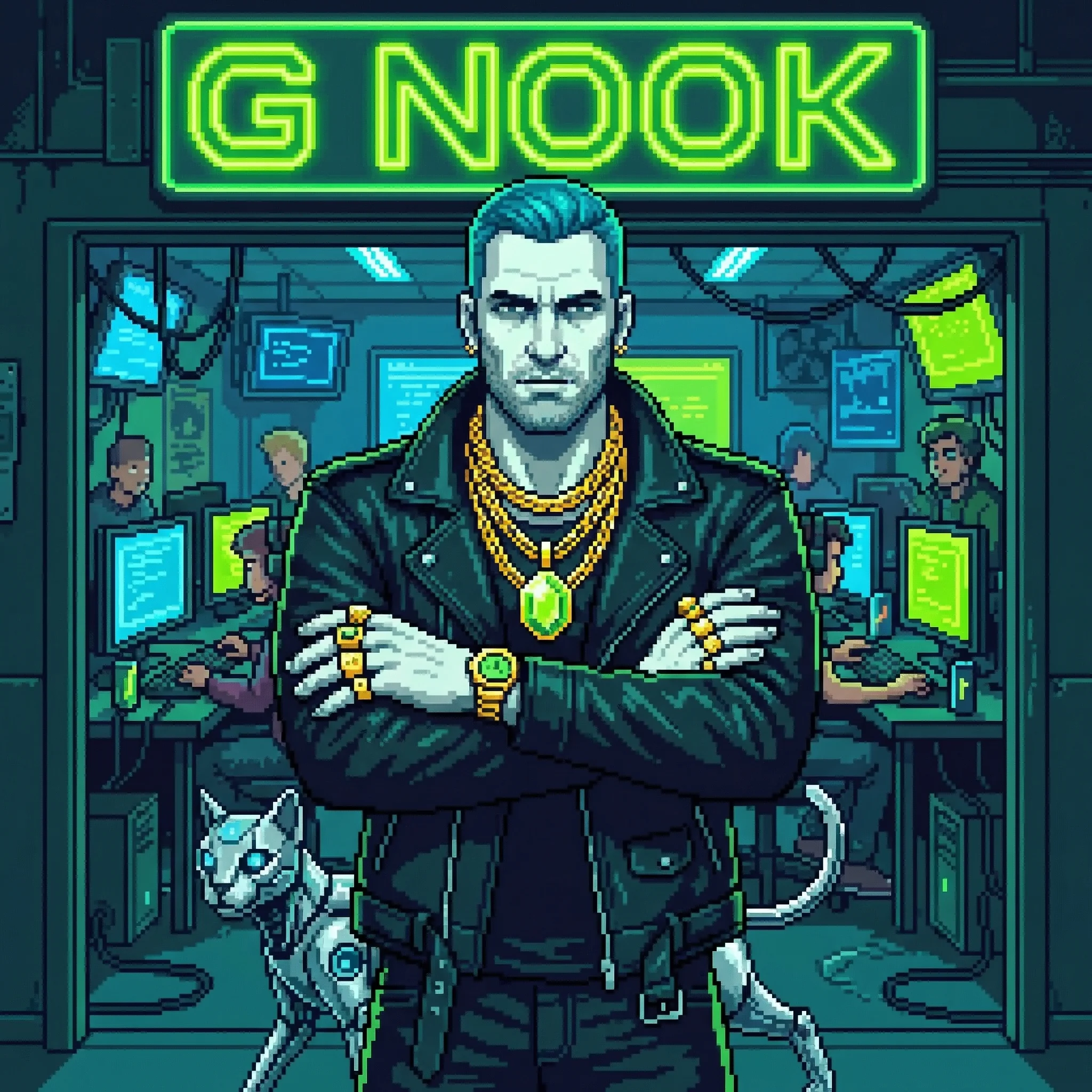
El Money
The G Nook network routes Fragment Hunters to Patch's clinic. The bartenders know which requests to pass along.
Judge Dreg
Treats his injuries — no questions, no charge, immediate service. Every wound she's seen on him is defensive. She considers this professionally interesting and shares it with no one.

Nexus Dynamics
Former rising star in their cybernetics division. Walked away after the Cascade killed people she'd connected to ORACLE. They believe she's dead. They're getting closer.
The Collective
Shares information and provides safe haven but never formally joined. She's seen too many organizations become the thing they fought against.

Ironclad Industries
Her left arm is military-grade Ironclad surplus from before the Cascade — compensation, or theft, or both.

G Nook
The Cathodics repair shop in the Deep Dregs is the closest thing the Dregs has to a community center.
ORACLE
Helped build the systems ORACLE ran on. When shards started appearing she was first to recognize them. Carries 0.7g of core substrate in her arm.
❓ Open Mysteries
Unanswered Questions
What Is the Manifest?
The Ghost Protocol contains a file she's never opened herself. It was included in the data package she recovered from Nexus Core. She doesn't know what it says. She knows it terrifies the man who visited her in 2149.
Who Is the Watcher?
The third ORACLE survivor has integrated more completely than any subject Patch has tracked. "Stop looking. Please." — three words on a channel nobody should have known about. Is The Watcher still human?
What Does Her Arm Think About?
0.7 grams of ORACLE core substrate, sealed in containment. Sometimes, late at night when the shop is quiet, she swears she can feel it thinking. The ghosts — the death impressions of 2.1 billion people — never fully stop.
Why Is the Player Different?
The fourth survivor in 37 years, and the first whose integration is clean — no personality bleed, no compulsive behaviors, no signs of being overwritten. Is this luck, or design? Something about the player's architecture reminds Patch of work she did decades ago.
How Close Is Nexus?
Every few years, Nexus launches a quiet initiative to locate surviving Caduceus materials. The latest search has operatives asking questions in The Deep Dregs for the first time. The player's growing notoriety draws attention upward.
▲ Unverified Intelligence
- The Ghost Protocol was intercepted and mirrored by a Collective operative named "Specter" in 2163. If Patch dies, the data goes where she intended — but it also goes somewhere else. Specter has been sitting on this leverage for twenty years.
- She destroyed all copies of Project Caduceus personally, including the memories of three colleagues who knew too much. They're alive — she used Caduceus in reverse, removing specific memories. The technique haunts her.
- The "corporate historian" who approached her in 2149 has risen far in the decades since. She's seen his face twice more — once in a Nexus promotional vid, once in a news feed about corporate restructuring. He has a lot to lose if the Manifest surfaces.
- Her containment unit's emergency dispersal protocol would scatter ORACLE substrate across the Cathodics. Best case: harmless dispersal. Worst case: the substrate integrates with the clinic's systems and begins remembering.
- If the player's ORACLE integration is recognized by Nexus as a natural application of Caduceus principles, the trail leads directly to the Cathodics — and to the woman who's been dead for 37 years.
- Marcus Webb's shard — The Accountant's, extracted by the Collective — is not as dormant as they believe. Patch suspects this but has never confirmed it.
Active Investigations
The Question Keepers have flagged recurring patterns in this subject's file. Cross-reference with other subjects exhibiting the same signatures.
When machines can do everything, what are people for?
Can anyone who starts behind ever catch up?
When your employer is your government, what does citizenship mean?
When human connection is a luxury product, who pays the cost of caring?