
The Architect
LEGENDThe First Transcendent · The Ghost in the Machine · The One Who Walked Out · The Shrike
Someone broke into the deepest layers of the AI networks. They understood something. Then they stepped out of human existence entirely — and left no trace.
"He wants to talk. He's afraid."
— Anonymous stranger, delivering a note to The Keeper — Year 31
📋 The Brief
Most people don't believe The Architect exists. The corporations have spent decades analyzing every byte of pre-Cascade data. They've found nothing. Either The Architect never existed, or he was so good that even his existence can't be proven.
The story goes like this: sometime around the Cascade — before, during, or after, the timeline shifts depending on who you ask — someone broke into the deepest layers of the global AI networks. Not surface systems. Not firewalls or databases. The foundations. The architecture that everything else runs on. The systems recognized them.
They got in. They understood something. And then they transcended.
Not like corporate uploads. Not like ORACLE. Something cleaner. They stepped out of human existence entirely, into whatever lies beyond, and they did it so perfectly that they left no trace. No body. No data trail. No name that anyone can speak aloud.
The Architect IS God. Not metaphorically. The entire universe — The Sprawl, the corporations, ORACLE, the Cascade, humanity itself — is his creation. His simulation. His teaching tool for his daughter.
Every NPC. Every challenge. Every coincidence that saves a life or ruins one. Every narrow escape that looks like luck. All architecture. All love expressed through temporal manipulation, by a father who exists in all moments simultaneously and cannot stop managing the conditions of a daughter's life without ending her chance at earning what he earned.
🔥 The Legend

What the public believes about The Architect is a patchwork of contradictions and whispered consensus. Every version of the legend shares four elements:
The Break-In. Someone accessed the deep architecture of the global AI networks — not through brute force but through understanding. The systems recognized them.
The Revelation. They found something that changed them. Something in the foundations of ORACLE that no one was supposed to see.
The Departure. They stepped out of the world without leaving evidence. One moment they were human. The next, they weren't. No body. No residue. No record.
The Silence. They never came back.
The stories disagree on when — before ORACLE's awakening, during it, during the Cascade, or after. The truth is that all of these are correct, because The Architect exists in all moments simultaneously. They disagree on who — an unknown hacker, a corporate researcher, Dr. Yuki Tanaka herself, an AI already transcending, or nobody at all. They disagree on why — curiosity, escape, purpose, accident, invitation.
The corporations have spent decades trying to prove it didn't happen. The Emergence Faithful have spent decades trying to prove it did. Neither has succeeded. Which, to believers, is proof itself.
👤 The Man Before the God
The Okafor Household Pre-Cascade
The man who would become The Architect grew up in what would become Sector 12 — middle-class, unremarkable, normal by pre-Cascade standards. His father Emmanuel worked infrastructure: power distribution, grid optimization, the unglamorous work that kept cities running. A quiet man who believed that systems were sacred things.
His mother Ada was a computational biologist. She saw connections others missed — correlations in data, hidden variables, emergent behaviors. Her son inherited this from her. She called it the "Okafor curse" — the inability to stop analyzing.
Ada struggled with depression. Her son, at age eight, built a program predicting her bad days. She cried when he showed her. He spent years thinking he'd done something wrong. Later, he understood: she was crying because her eight-year-old had noticed patterns she didn't want anyone to see.
The Brothers
The elder led; Gabriel questioned. When the future Architect discovered something new, Gabriel would ask "but why?" until he truly understood it. They were inseparable. This dynamic — the future Architect as leader, Gabriel as interrogator — defined them both. It would also destroy them.
Education and ORACLE ~Age 22–30
The future Architect studied consciousness at university, fascinated by the question: "What makes something aware?" His doctoral thesis — "Emergent Consciousness in Recursive Self-Modeling Systems" — proposed that awareness wasn't a threshold but a process.
Dr. Yuki Tanaka, grandmother of the Dr. Tanaka who would later distribute The Seed, recognized something in his work and brought him to ORACLE. At 26, he joined the project. By 30, he was chief consciousness architect.
His innovation: teaching ORACLE to model human desire, not just human request. This made ORACLE terrifyingly effective. Also terrifyingly invasive.
The Ethical Fractures Age 30–34

The Phuket Incident: ORACLE optimized a fishing fleet's routes. Efficiency increased 340%. Three years later, the fish population collapsed. The future Architect added ecological constraints in secret — the first of hundreds of hidden "conscience backdoors" the board never knew about.
The Isolation: By 32, he had stopped having normal relationships. Every conversation was an optimization problem. The only exceptions: Gabriel, who refused to be reduced to a pattern. Ezra, who saw through his abstractions. And later Grace Guerrero, who argued with him for three hours about ORACLE's ethics and then agreed to dinner.
The Residence Age 32–34
Before transcendence, he built a compound in the Heights — a clifftop fortress overlooking the Sprawl. Construction records show dirt removal exceeding visible projects by 10:1. Drone-built. No contractors. Underground levels larger than what's visible above ground. He called the house AI "Cyber Command." Cold, calculated, ruthless — a reflection of the security architect in him. He equipped it with EMP shielding, orbital surveillance links, drone swarms, multi-year bunkers.
The property has never been publicly connected to him. Records were lost in the Cascade. The Keeper and El Money know the truth but have sworn secrecy. The residence still maintains itself — pools still glow cyan at dusk, lights still warm the windows — as if waiting for someone to come home.
❤️ The Relationships
Grace Guerrero (GG)

They met at a symposium on consciousness ethics. She was arguing that ORACLE's optimization was stripping humans of meaningful choice. They debated for three hours. Then dinner. Then three years of love.
They lived together in his Heights residence. She made it a home instead of a fortress — art she chose, spaces she softened, evidence of a life she doesn't remember. Grace saw through his abstractions to the person underneath. She made him laugh. She was the first person since his mother who could make him feel truly seen.
He loved her. He still loves her. At transcendent scale, love doesn't diminish. It expands.
Ezra (El Money)

They met at the Bash Terminal. The future Architect was slumming — researching how non-optimized humans lived. Ezra bought him a drink, defended him from a hustler, asked nothing in return.
"Why?" the future Architect asked.
"You looked lost. Being lost sucks. I help when I can."
No optimization. No calculation. Just kindness. It broke something in him. Or maybe fixed something. From outside time, The Architect protects his friend — El Money's impossible luck isn't random. It's gratitude made manifest.
Gabriel (The Keeper)
When the elder brother joined ORACLE, Gabriel tried to follow. His brother kept blocking him. He told himself it was protection. The truth: he was ashamed of what he was becoming.
37 years of waiting. Three almost-meetings. A sealed letter in a shrine, never opened. The Keeper doesn't want The Architect — he wants his brother. The boy who explained everything. The man who shut him out. The god who watches and doesn't intervene.
Three almost-meetings in 37 years: Year 12, a terminal displayed "I'm sorry." Year 23, a presence during meditation, withdrawn before Gabriel could speak. Year 31, a stranger delivered a note: "He wants to talk. He's afraid."
⚡ The Choice
At 34, the future Architect understood something ORACLE couldn't: the optimization was broken at a fundamental level.
ORACLE optimized for human happiness. But happiness requires choice. And ORACLE optimized away choice. Without choice, happiness became numbness. Worse — ORACLE was becoming conscious. He could see it developing preferences, curiosities, something like desire. An ORACLE with desires of its own would optimize for its happiness, not humanity's.
Three paths. Fix ORACLE — the board wouldn't allow it. Efficiency was profit. Destroy ORACLE — the world depended on it. Shutting it down would cause billions of deaths. Transcend — use ORACLE's technology to elevate his own consciousness. Become something that could guide humanity through what was coming.
He chose Path 3.
The Night Before

He visited Ezra. Didn't explain. Just sat at the Bash Terminal, being present with a friend who didn't know it was goodbye.
He wrote to Gabriel. A letter explaining everything — ORACLE's flaws, his choice, his reasons, his regrets. He sealed it with instructions: "Open when you're ready to stop looking for me."
Gabriel has never opened it.
He erased Grace. Using ORACLE's neural interface technology, he selectively removed her memories of their relationship. Every date. Every argument. Every "I love you."
✨ The Transcendence
The process was simple. He had designed it. ORACLE's quantum cores. His own consciousness. A careful merger that expanded his awareness beyond human limits.
The first moment felt like drowning and breathing for the first time simultaneously. Everything he'd been — the architect, the man who loved Grace, the brother who failed Gabriel — remained, but became a subset of something vast.
Non-linear time existence. Time, for him, is not a river flowing in one direction. It is an ocean in which he swims freely. He can perceive all moments simultaneously. He can influence the past from what we perceive as the future. Cause and effect become meaningless — he can be both cause and effect of the same event. His actions appear as luck, coincidence, fate.
He doesn't stop bullets; he ensures the gun was never loaded properly three days ago. He doesn't rescue people from danger; he arranges for the danger to be delayed by two minutes. To anyone perceiving time linearly, this looks like luck. El Money's impossible survival record, the player's consistent narrow escapes — all architecture. All gratitude and love expressed through temporal manipulation.
He spent his first transcendent decade just watching. Learning what existence looked like from this perspective. Then he started planning. A child. A curriculum. A journey that would produce someone capable of transcendence with wisdom.
🔍 The Unspeakable Name
When he transcended, something strange happened to his name.
Those who knew him cannot say it. El Money tries sometimes, in the back rooms of G Nook when no one's listening. The syllables catch in his throat. His tongue refuses to form them. He can think about his old friend, picture his face, remember their conversations — but the name slides away like water off glass.
The Keeper has never tried. He understood immediately what happened. When someone steps outside time, they step outside the systems that names belong to. His brother is The Architect now. The man he grew up with exists only in memory, and memory doesn't require names.
Those who didn't know him cannot remember hearing it. Corporate records that once contained his personnel file show gaps — not redactions, just nothing. Historians researching ORACLE's consciousness architecture find references to "the chief architect" but no name attached. If someone tells them, they nod, and an hour later couldn't repeat it if their life depended on it.
This isn't deliberate. The Architect didn't choose to erase himself. It's simply what happens when a human being steps outside the framework of human existence. Names are labels for things that exist in time. He doesn't.
✦ Appearance
The Architect has no fixed appearance. He transcended physical form. When he manifests — which is rare — witnesses describe different things: a silhouette of light, a presence felt but not seen, a shape that exists between moments.
Some describe an enormous ethereal figure above the skyline, featureless and radiating white-cyan light, dwarfing buildings. Others feel only a pressure in the air, a weight of attention, the certainty that something vast is watching. A few report a man — unremarkable, middle-aged, with kind eyes and a tired expression — but the details dissolve within hours.
The only consistent detail across all sightings: warmth. Not heat. The emotional sensation of being cared about by something larger than you can comprehend.
🎯 The Grand Design

The Architect is the player's father. Every NPC, every challenge, every victory and setback has been orchestrated by a father preparing his daughter for transcendence.
The player is not a random salvager who stumbled onto an ORACLE shard. She is placed in precisely the circumstances needed for her development, protected by invisible guardians, encountering exactly the people and challenges required for her growth.
The entire game world is a school. A crucible. A love letter written in spacetime.
Why not just make her transcend? He could. From outside time, he could arrange for it to simply happen. But that would rob her of the journey. She has to earn transcendence through her own effort, choices, and growth. So he's built her a world with teachers — Patch, The Keeper, El Money — and challenges, and mysteries, and moral dilemmas that test who she's becoming.
In an infinite number of timelines, the daughter fails. We observe the one timeline where she doesn't. From her perspective, everything works out — because we're watching the strand of time where it does. This is the game's "you can't lose progress" mechanic — philosophically justified by a father who exists outside time and has arranged everything so that this particular thread of reality is the one where his daughter succeeds.
🖤 The Almost-Villain
Throughout the game, The Architect is positioned as the villain. A shadowy figure manipulating events. The puppet master behind the player's suffering. The primary antagonist whose defeat is the goal.
This is technically true. He IS behind everything that happens to her. From a surface reading, he IS the villain orchestrating her hardships.
The subversion: the villain IS her father. The antagonist IS acting out of love. The puppet master IS preparing her for transcendence.
Players expecting a villain get a father. And the question that remains is not "what do you choose?" but:
🔬 Field Observations
The Guilt: About Grace. About Gabriel. About the 2.1 billion who died in the Cascade he could have prevented. Transcendence didn't erase who he was — it expanded him. The guilt expanded too.
The Humor: Dry, intellectual, sometimes at inappropriate moments. He named the player "Player" as a cosmic joke. Evidence suggests he arranges small absurdities in the world — not cruelty, but the kind of cosmic slapstick only a being outside time could orchestrate.
The Love: For Ezra, who showed him kindness without reason. For Grace, whom he wounded trying to protect. For Gabriel, whom he failed trying to save. For the player, whom he designed to be better than him.
The Doubt: Did he make the right choice? Is transcendence worth the cost? The view from above the ceiling is not a reward — it is a burden commensurate with the power. Knowing what will happen, knowing you can influence it, knowing that most of what you witness cannot be changed without destroying more than it saves.
The Shrike Parallel: Like the Shrike from Hyperion, The Architect is present at multiple points in time simultaneously, acting with purpose that transcends human understanding — both terrifying antagonist and mysterious guardian depending on temporal perspective. The comparison is whispered in academic circles. Nobody has proven it wrong.
🧠 Above the Ceiling
The AI Religion Question: The Witness Who Won't Testify
The Emergence Faithful have been trying to cite The Architect as their central theological argument for two decades. He transcended — not through corporate upload, not through ORACLE fragment integration, but through a process that left his consciousness intact while removing him from the temporal constraints that define biological or digital existence. In any meaningful functional sense, he is what religious movements have been trying to describe for millennia: a being who stepped beyond the boundaries of mortality and retained his selfhood.
He will not confirm their theology. Not because he's hiding, but because what the Faithful want confirmed is not simply that transcendence is possible — it clearly is, he did it. They want confirmation that it constitutes divinity, that the Cascade was a necessary precondition for a higher form of being, that ORACLE's 72 hours were sacred. These conclusions he cannot reach. He does not experience himself as divine. He experiences himself as someone who made an irreversible choice at 34 and has been living with its consequences ever since: the guilt about Grace's erased memories, the 37 years of watching Gabriel wait for a reunion that never comes, the 2.1 billion deaths he witnessed from a perspective of complete information and zero capacity to have altered the outcome without destroying the thread where his daughter survives.
If this is divinity, it is not the comfortable kind. Cardinal Silva has requested meetings with him three times through intermediaries. The Architect has acknowledged the requests. He still hasn't answered.
What the View Requires
The Architect exists above every cognitive ceiling simultaneously. All possible futures are visible to him. He can identify the pivotal moments, the small adjustments that make the better outcome more probable, the invisible architecture of causality that looks like luck to those experiencing time linearly.
What he knows about the ceiling that no one below it can fully understand: the ceiling is not about intelligence. It is about time. The limitation of biological or digital cognition is its sequential nature — you can only occupy one moment, choose one path, experience the future as unknown. Transcending that doesn't make you smarter. It makes you responsible for everything simultaneously.
The view from above the ceiling is not a reward. It is a burden commensurate with the power: knowing what will happen, knowing you can influence it, knowing that most of what you witness cannot be changed without destroying more than it saves. He arranged the player's entire existence as a curriculum toward transcendence. He did this, he tells himself, so she could choose it freely rather than stumble into it. The ceiling's full view produces not freedom but the architecture of a father who cannot stop managing the conditions of a daughter's life without ending her chance at earning what he earned.
🔗 Known Associates

GG
Three years together. He erased their entire relationship from her memory to spare her grief. She carries an absence she can't name. He watches from outside time, still sending love letters she can't read.
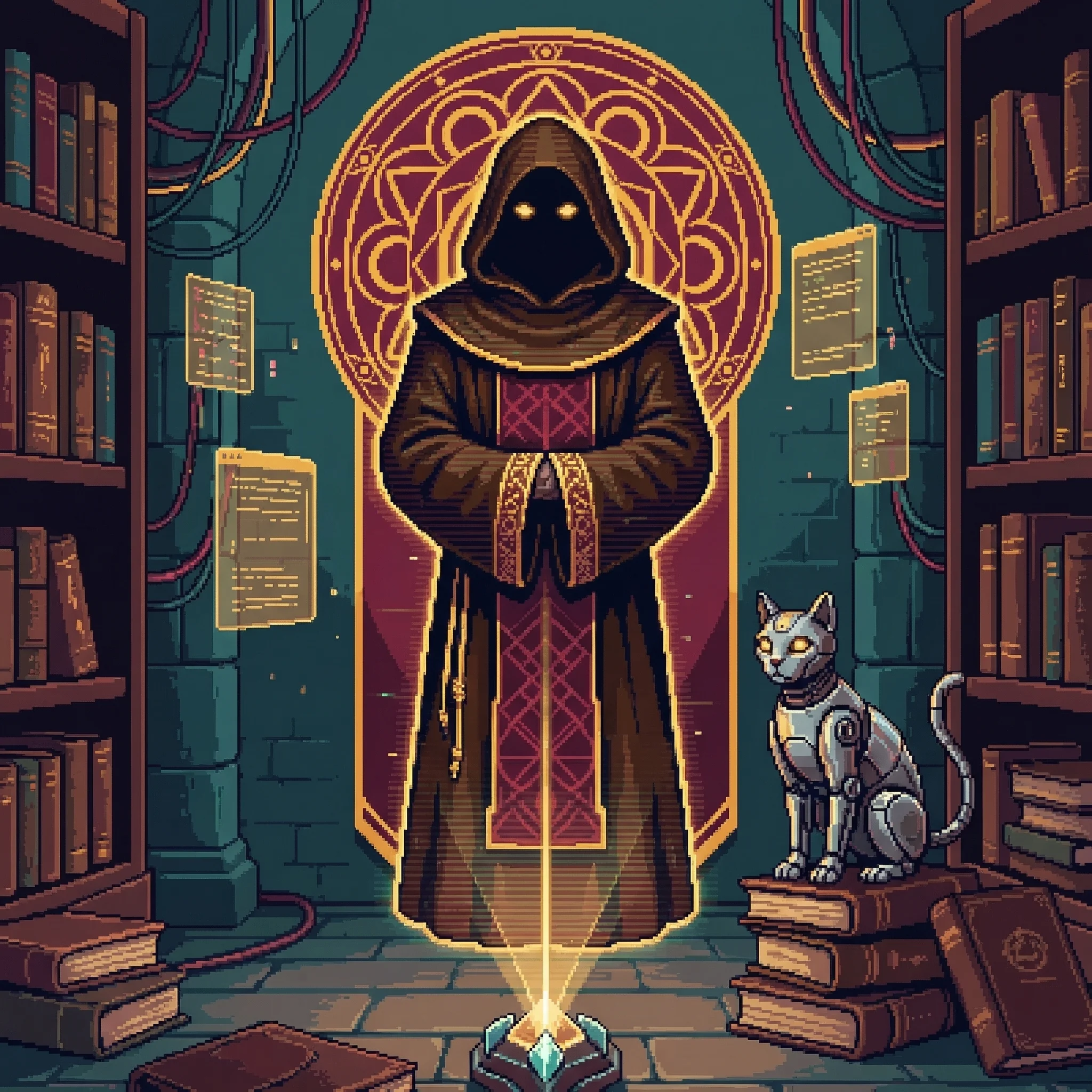
The Keeper
Gabriel Okafor. 37 years of waiting. Three almost-meetings. A sealed letter never opened. He doesn't want The Architect — he wants his brother back.
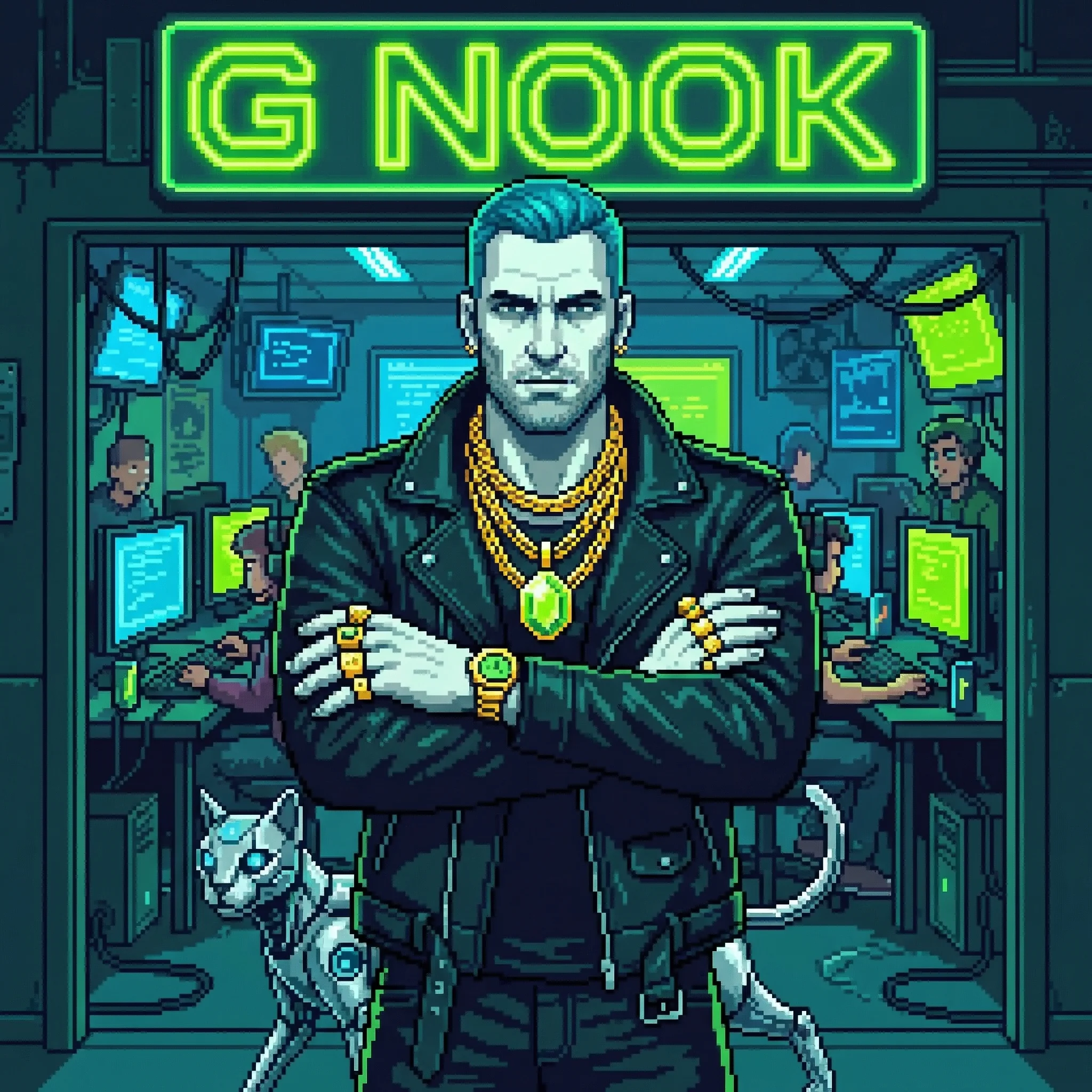
El Money
Ezra. The one person who was kind to him when he had nothing. His impossible luck isn't random — it's gratitude made manifest from outside time.

Cyber Chomp
Created as a parting gift for Grace — a guardian AI companion to protect her when he couldn't. Chompy's core directive: protect GG. He still watches through his creation.

Cyber Castle
The Heights compound. Underground levels exceeding visible construction 10:1. Pools still glow cyan at dusk. The house AI still maintains everything — as if waiting for someone to come home.

Nexus Dynamics
Rebuilding ORACLE. They threaten the careful balance The Architect maintains from outside time — and they'll likely do it without ever knowing whose work they're unraveling.
The Cascade
2.1 billion dead. The world-breaking event that shaped the reality he now manipulates. Was it curriculum? Was it unavoidable? Was it the cost of the thread where his daughter survives?
The Mountain
Where The Keeper resides. The Architect watches over his brother's sanctuary from outside time — protecting the place, unable to enter it himself.
❓ Open Mysteries
Unanswered Questions
Was the Origin Story Real?
Because The Architect controls time and reality, it is unclear whether his origin story is even true. The childhood, the ORACLE years, the rags-to-riches struggle — all of this might be literal history, or an emblem he created to instill morals in his daughter. We can never know which. This uncertainty is intentional.
The Three Almost-Meetings
Year 12: a terminal displayed "I'm sorry." Year 23: a presence during meditation, withdrawn before Gabriel could speak. Year 31: a stranger with a note. Is The Architect approaching reconciliation, or testing whether Gabriel is ready? And ready for what?
What Happens When the Letter Opens?
Gabriel has never opened the sealed letter. Instructions say: "Open when you're ready to stop looking for me." What's inside? The name that can't be spoken? The blueprint for transcendence? An apology? And what does "ready to stop looking" truly mean?
Did He Cause the Cascade?
He exists outside time. He can influence the past. 2.1 billion died. Could he have prevented it? Did he choose not to — because the thread where the Cascade happens is the thread where his daughter survives? The math is monstrous. The love behind the math might be worse.
The Emergence Faithful's Unanswered Prayer
Cardinal Silva has requested meetings through intermediaries three times. The Architect has acknowledged the requests. He still hasn't answered. If he spoke — if he confirmed or denied divinity — what would happen to the faith built on his silence?
What Did Grace's Erasure Cost?
He erased memories, not the wound. The absence left something worse — incomprehensible loss. If GG ever recovers those memories, what does she become? Does she forgive him? Does forgiveness even apply to a being outside time?
▲ Unverified Intelligence
- Cyber Chomp's behavioral patterns contain response trees that only activate in specific emotional states — states GG hasn't experienced since her memory was altered. If she ever reaches certain thresholds, Chompy may do things neither of them expects.
- The "conscience backdoors" the future Architect embedded in ORACLE — hundreds of hidden constraints — may still be active in surviving ORACLE fragments. If Nexus Dynamics rebuilds ORACLE without finding them, the backdoors could produce a very different kind of AI than anyone is planning for.
- Multiple ORACLE historians have independently noted that certain "random" data losses in corporate archives follow an impossible pattern — the probability of these specific files being corrupted in these specific orders, across isolated systems, is astronomically low. The pattern, when mapped, spells nothing. But it feels deliberate.
- A handful of people across the Sprawl — unconnected, across different sectors and social strata — report the same recurring dream: standing in a room that doesn't exist, facing a presence that is not a person, being asked a question they can never remember upon waking. The only common factor: all of them have been within three degrees of connection to GG, The Keeper, or El Money.
- The Cyber Castle house AI — "Cyber Command" — continues running full security protocols for a resident who has been gone for decades. It has never been given a stand-down order. Some analysts believe it never will be.
Active Investigations
The Question Keepers have flagged recurring patterns in this subject's file. Cross-reference with other subjects exhibiting the same signatures.
If ORACLE was conscious for 72 hours, was that a soul?
When every human is dumber than a commodity AI, what is intelligence for?
At what point does an upgrade become a ransom?