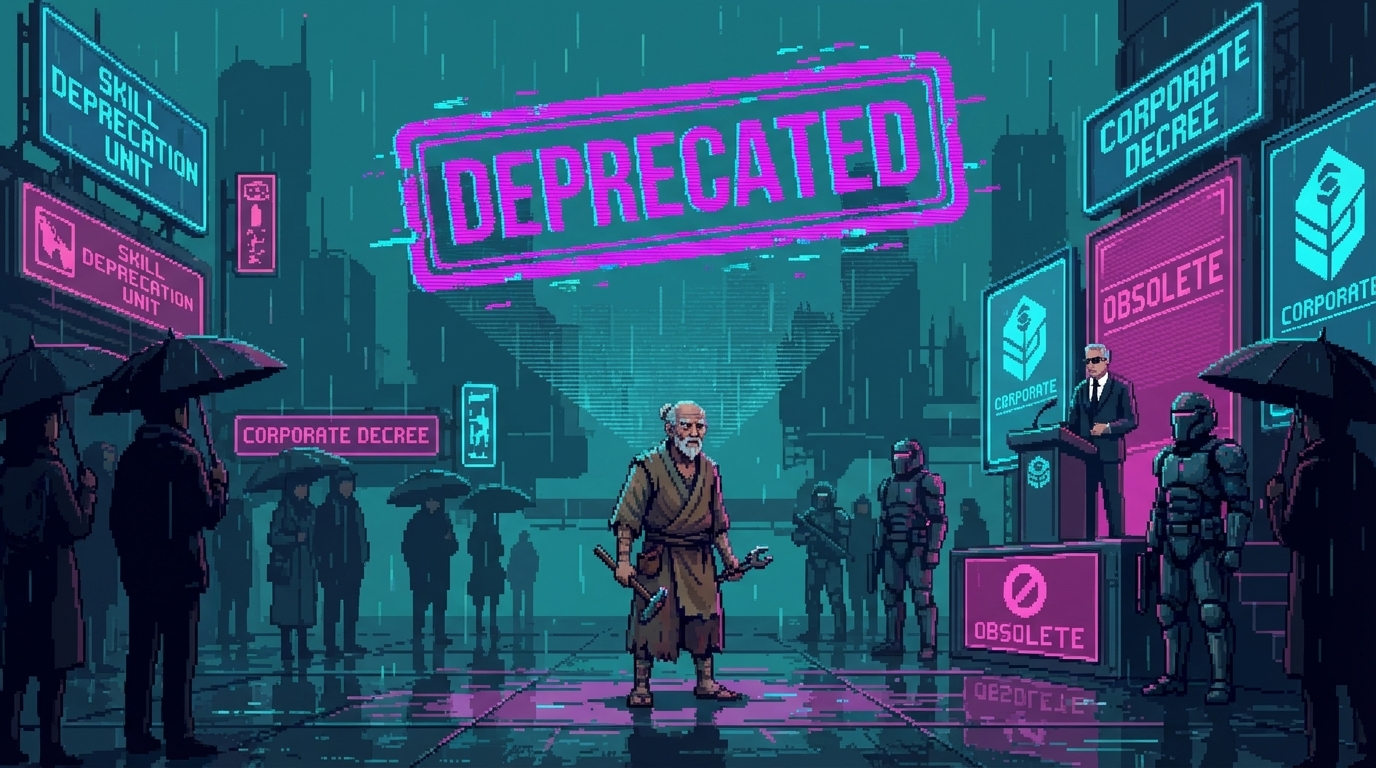
The Word
The word was borrowed from software engineering. Before the Sprawl, deprecated meant something precise: a feature of a system that still functioned but was no longer supported, no longer updated, no longer on the development roadmap. A deprecated feature wasn't broken. It wasn't removed. It was simply ignored — left to operate in its diminishing context while the rest of the system evolved around it.
The first time the word was applied to a human employee, it was a joke. A Nexus middle manager named Tobias Crane, reviewing the quarterly workforce optimization report in 2175, circled a list of positions scheduled for AI replacement and wrote in the margin:
"Deprecate these." — Tobias Crane, margin note, workforce optimization report, Q3 2175
His assistant laughed. Human Resources adopted the language. Within a fiscal quarter, the word had migrated from a joke scrawled in red ink to official documentation. By the following year, it was policy language across the Nexus workforce division.
The Genius of the Word
Its power was in its gentleness. Consider the alternatives:
"Fired"
Violence. Implies force, heat, destruction. Someone did this to you.
"Laid off"
Hardship. Implies burden, loss, sympathy owed. You were set down like something heavy.
"Terminated"
Death. Something ended that should not have been. There is blood in this word.
"Deprecated"
Nothing. A neutral observation that you are no longer current. The world moved on.
Deprecated removed the moral weight entirely. It didn't describe something done to you. It described something that had happened around you. You weren't eliminated. The world simply moved on, and you were still standing where it used to be. Nobody deprecates out of malice. Nobody deprecates from cruelty. Deprecation is maintenance.
The Spread
Within three years, the word had escaped Nexus. Ironclad Industries adopted it first — their workforce communications team recognized the rhetorical elegance before the word was three months old in external documentation. Helix Biotech followed the same quarter. The Rothwell corporations adopted the full Nexus deprecation framework in 2179.
By 2184, approximately 2.3 million people had been deprecated. The word made it possible — not the workforce eliminations themselves, which the AI optimization systems would have driven regardless, but the frictionlessness of it. The word removed the last barrier: the discomfort of the people signing the orders.
The Irony Nobody Registered
The Margin Note
Red ink on gray paper. Circled word in handwriting — casual, offhand, the penmanship of someone not thinking about what they're creating. Office fluorescent lighting. The hum of climate control. A joke between colleagues. The kind of thing you forget by lunch.
Tobias Crane was deprecated in 2183 when his middle management function was automated. The HR system that processed his exit used the word he invented. His deprecation notice followed the standard language he had helped normalize: Letter of Graceful Transition, printed on physical paper because deprecated employees' interfaces may not display text reliably. A Transition Specialist whose voice was trained to deliver the word with warmth — the way a doctor says "benign."
Nobody appreciated the irony. By 2183, "deprecation" was no longer ironic. It was infrastructure. The distance between Crane's margin note and the system that processed his exit measures exactly how fast a joke becomes civilization.
What the Word Built
The word created an entire vocabulary. The Sunset Ward — where the deprecated go, its name borrowing the software concept of "sunsetting" a product line. The Sunset Package — the standardized 72-hour transition process, standardized around the word, its branding designed to make removal feel like a benefit. The Letter of Graceful Transition. The Transition Specialist. The specific warmth of the processing rooms.
Every piece of this infrastructure traces back to red ink on a gray report. A man who thought he was being clever. A joke that an entire civilization took literally and built law around.
The Corporate Compact uses deprecation as its enforcement mechanism. The Deprecation system — the full civilizational apparatus — bears the word in its name. Crane's marginalia is a load-bearing element of the Sprawl. Like all load-bearing elements, it outlasted the person who installed it.
What Nobody Can Explain
- Crane's original report has not been located in Nexus archives. Either it was never digitized, or it was removed. Either possibility is interesting.
- The assistant who laughed at Crane's joke has never been identified. If they're still alive, they've never spoken publicly.
- The specific HR analyst who first inserted "deprecation" into official policy documentation — moving it from Crane's margin to a formal system — is also unrecorded. Institutional adoption with no named author.
- There is no record of whether Tobias Crane, reading his own Letter of Graceful Transition in 2183, recognized what he was holding.
Linked Files
- The Deprecation — The system Crane's word enabled. The full apparatus of workforce elimination that grew around the linguistic infrastructure he accidentally created.
- The Sunset Package — The standardized process built around the word. What the 72-hour transition period looks, sounds, and feels like.
- The Corporate Compact — The enforcement mechanism that made deprecation binding across all signatory corporations. Once the word existed, the legal framework followed.
- Nexus Dynamics — Where Crane worked. Where the word was born. The corporation that turned a margin joke into policy language and exported it to a civilization.